
The St. Louis City Probate Division
The Probate Division is part of the 22nd Judicial Circuit. It sits on the 10th floor of the courthouse at 10 North Tucker Boulevard. The division administers the cases of people who have died. It also holds general supervisory power over the estates of minors and of adults a court has found disabled or incapacitated. Two probate commissioners hear these matters, Jill M. Hanley and Kevin B. Anderson.
The court explains that when a person cannot handle their own affairs, because they are underage or disabled, the division can step in. After an application, a hearing, and a finding, the court may name a conservator to manage money or property. It may also name a guardian to handle care and custody. The official Probate Division page lists the contact block and commissioners.
Probate sits beside the other parts of the court. For general case lookups, see the St. Louis City court records page, and for the office that keeps court files, see the Circuit Clerk page.
Probate Division, 22nd Circuit
10 North Tucker Boulevard, 10th Floor
St. Louis, MO 63101
Phone: 314-622-4238
Fax: 314-622-4498
Legal Counsel: 314-622-4676
Mon-Fri 8:30 a.m.-5:00 p.m.
What St. Louis City Probate Records Cover
Probate is broader than wills. The division handles several kinds of cases, and each one creates its own file. A decedent estate deals with the property of a person who has died. A will case proves or contests that person's last wishes. Guardianship and conservatorship cases protect minors and incapacitated adults. The forms library even covers civil detention and involuntary commitment matters tied to mental health.
Here are the main record types the St. Louis City Probate Division holds.
- Decedent estates - the property, debts, and distribution of a person who has died.
- Wills - documents that set out a person's wishes, including proven and unproven wills.
- Guardianship - care and custody of a minor or an incapacitated adult.
- Conservatorship - management of another person's money and property.
- Minor and disabled-adult estates - estates the court supervises for protected people.
- Civil detention - involuntary commitment and treatment forms tied to mental health.
These files hold sensitive material at times, so some parts are open and some are closed by law.
Key St. Louis City Probate Terms
Probate uses words that do not come up much in daily life. A few short definitions make a St. Louis City probate records search clearer. These terms show up across estate files, will cases, and guardianship matters.
- Testator
- A person who makes a will.
- Executor
- The person named in a will to carry out its terms and settle the estate.
- Intestate
- Dying without a valid will, so state law decides who inherits.
- Guardianship
- A court arrangement for the care and custody of a minor or an incapacitated adult.
- Conservatorship
- A court arrangement to manage another person's money or property.
With these terms in hand, the rest of the probate process is easier to follow.
How to Search St. Louis City Probate Records
There is more than one way to reach a probate file. Recent cases can be requested from the division. Older cases run through a separate historical index. Case information may be requested by mail to the Probate Division at 10 North Tucker Boulevard. Requests can also be faxed to 314-622-4498.
For source documents and copies, the division uses a fillable probate records request form. You email the form to CT22.probateresourceroom@courts.mo.gov, or you submit the webform at the bottom of the division's page. Copying fees may apply. Historical files have their own path through the Missouri State Archives County and Municipal Records Database. That database is not searchable by name or subject. You browse it by county, which is St. Louis City, then by office, which is the Probate Court, then by record type and date.
Many newer cases also appear in Missouri Case.net under "City of St. Louis - 22nd Judicial Circuit." Pick the probate case type to narrow the list. The same search path serves a broader court records lookup, and divorce or marriage matters route to the marriage and divorce records page instead.
The Historical Probate Case Index
Old probate files predate any computer system. The division keeps a Historical Probate Case Index for them. It covers decedent estates filed from 1890 to May 31, 2000. It also covers guardianships filed from 1815 to May 31, 2000. That guardianship range reaches back before Missouri became a state. The index gives you names, probate file numbers, and the date of death or date of guardianship.
The index is broken into letter ranges and special sections. You find the right section, locate the name, then use the file number to request the record. The fields below come from the historical index.
| Field | Type | Notes |
|---|---|---|
| Index section | Link / list | A-Di; D-Ho; Ho-Mi; Mi-Sch; Sch-Z; Refusal of Letters A-La; Refusal La-Z; Guardianships before 1890; Guardianships 1890 to May 31, 2000; No Letter Wills; Unproven Wills. |
| Name | Index value | The decedent or guardianship name. |
| Probate file number | Index value | Use this number in the records request. |
| Date of death / guardianship | Index value | The date field shown next to the name. |
The official Historical Probate Case Index hosts the section PDFs and the request instructions.
Note: The historical index lists names and file numbers only, so you must request the source documents separately to get copies.
St. Louis City Probate Forms
The court forms library carries a deep set of probate forms. They cover refusal of letters, guardian and conservator appointments, estate reports, and civil detention. You file the right form with the division based on the kind of case. The list below is a sample of what the library holds.
- Application for creditors, minors, or spousal refusal of letters.
- Petition for appointment of guardian or conservator, adult packet.
- Petition for guardian and conservator of a minor.
- Inventory and appraisement, plus report in lieu of settlement.
- Physician's affidavit and certification of a restricted account.
- Application for 96 Hour Detention, Evaluation and Treatment or Rehabilitation.
You can browse the full set on the court's forms page, which also holds family, protection-order, and self-represented litigant forms.
Guardianship and Conservatorship Records
Guardianship and conservatorship cases protect people who cannot fully protect themselves. A guardian handles care and custody. A conservator handles money and property. The court names one or both after an application, a hearing, and a finding. These cases stay under court watch, so files can include inventories, accountings, and reports. They also end. Missouri law sets out how a guardianship or conservatorship is terminated.
The end of a case is governed by statute. You can read the rule on termination at RSMo § 475.083.
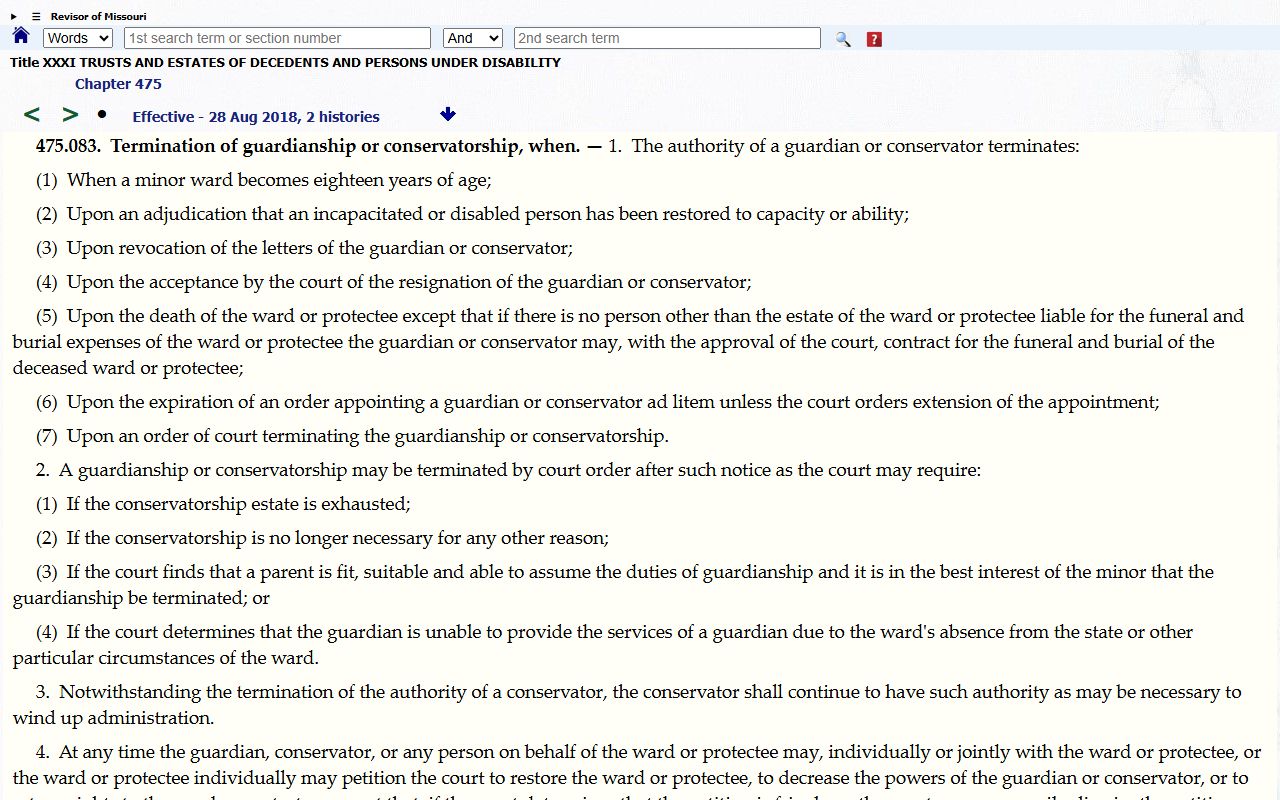
The statute explains when a guardianship or conservatorship ends, which helps when you read the final entries in a St. Louis City probate record.
Because these files can hold medical and personal detail, parts may be restricted. The public records page covers the open-records rules that decide what stays public.
How Probate Works Locally
A probate case moves through set steps in the 22nd Circuit. The path depends on the kind of matter, but the basic flow is steady. The steps below trace a typical case from filing through copies.
- Decide whether the matter is a decedent estate, refusal of letters, will, guardianship, conservatorship, minor estate, or civil detention case.
- Pull the right Probate Division forms from the official forms library.
- File with the Probate Division on the 10th floor at 10 N. Tucker, or through the approved e-filing or self-represented process.
- Pay the required probate filing fee, or seek a waiver if one is available.
- Attend the hearing if the case calls for one.
- The court decides appointment, authority, bond or account limits, inventory, reporting, and settlement.
- Request copies or historical files by mail, fax, email, or webform using the case or index number.
Each step can add a document to the file, which is why a single estate can grow into a thick record over time.
St. Louis City Probate Filing Fees
Probate cases carry filing fees, the same as other court matters. The court's navigation links to a Probate Filing Fees page. The exact probate fee amounts were not confirmed in the research, so it is best not to guess at a number. Check the official Probate Filing Fees page or call the division at 314-622-4238 before you file.
For context, the broader 22nd Circuit fee order does list general court costs. Those amounts are filing deposits and service fees, not probate-specific charges. Anyone settling an estate should ask the division about the current probate schedule and about fee waivers for those who cannot pay.
Note: Confirm current probate filing fees with the official Probate Filing Fees page or the division directly, since posted amounts can change without notice.