
How to Find St. Louis City Arrest Records
A recent arrest in the city shows up first at the jail, not the court. People arrested in the City of St. Louis are usually held at the City Justice Center or kept in police custody. The fastest way to confirm an arrest is the city inmate locator. It tells you whether a person is in custody right now and lists the charge, the case number, the bond, and the next court date.
The locator returns exact matches only. A misspelled name or an alias can hide a real record. Type the full first and last name as it appears on the arrest paperwork. If no name is entered, the tool returns a list of everyone currently held. There is also a tab for people released in the past 72 hours.
The official city arrest and incident report statute sets the rule for what arrest data is open to the public.
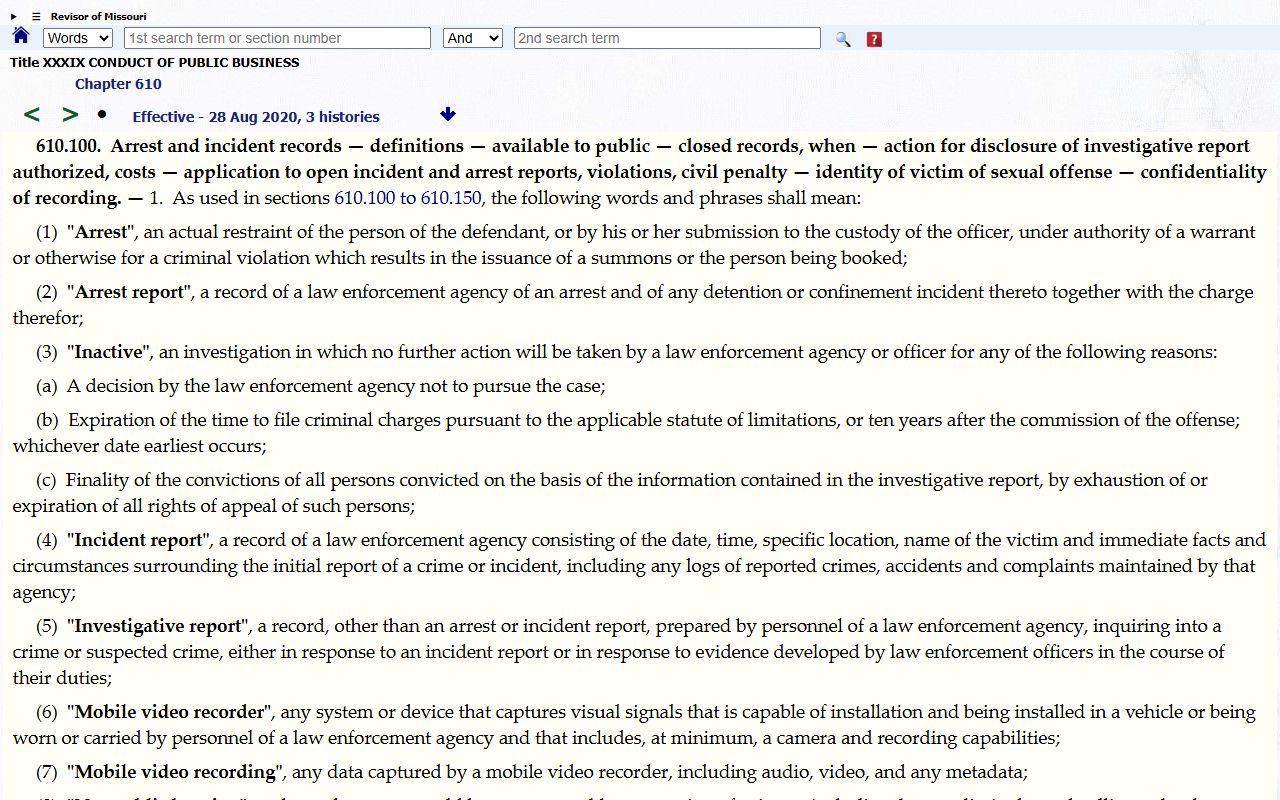
Under that law, basic St. Louis City arrest records can be open while an active investigation report stays closed. For the booking roster itself, the St. Louis City inmate records page walks through the locator step by step.
Booking and the City Justice Center Roster
Booking is the intake process after an arrest. Staff record the person's name, take a photo, list the charge, and assign a place to hold them. The City Justice Center is the city's main jail. It sits at 200 South Tucker Boulevard and runs 24 hours. The facility opened in 2002 and can hold 860 people.
The roster shows who is held and on what. It is the closest thing the city has to a public arrest blotter that updates in near real time. A few facts shape what you see. A person booked minutes ago may not appear yet. Someone held on the first floor in police custody, or at a substation awaiting transport, may not show in the jail roster. And once a person is released, they drop off the active list.
If a name does not appear but you believe the person is in police custody, call SLMPD Prisoner Processing at 314-241-8339. For the City Justice Center itself, the number is 314-621-5848.
City Justice Center
200 South Tucker Boulevard
St. Louis, MO 63102
314-621-5848
Open 24 hours
Bond status and release timing for these St. Louis City arrest records run through the jail and the bond lines, which are covered further down.
What St. Louis City Arrest Records Show
An arrest entry on the jail roster carries a set group of fields. The data is informational and can change fast. An arrest is not a conviction and does not imply guilt. Still, the fields tell you a lot about where a case stands right after the arrest.
| Field | What It Shows |
|---|---|
| Inmate Name | Last, first, and middle initial as booked. |
| Year of Birth | Birth year used to confirm identity. |
| Race / Sex | Single-letter codes shown on the profile. |
| Facility | Where the person is held. |
| Arrest Date / Time | When the person was taken into custody. |
| Charge | The offense listed at booking. |
| Case # | The court case tied to the charge. |
| Next Court Date | The scheduled hearing, if set. |
| Bond Amount / Type | The amount and form of bond required for release. |
Note: The jail roster is a snapshot of custody, not a certified record, so always confirm a charge or date with the court before relying on it.
Arrest Record vs Criminal Court Record
People mix these two up all the time. An arrest record comes from the police and the jail. It marks that a person was taken into custody. A criminal court record comes from the 22nd Judicial Circuit. It tracks the case the prosecutor files after the arrest. One arrest can lead to a court case, no case, or a case that is later dropped.
| Arrest Record | Criminal Court Record |
|---|---|
| Created by police at the time of arrest | Created when the Circuit Attorney files charges |
| Held by the jail and law enforcement | Held by the Circuit Court and Circuit Clerk |
| Found on the jail roster and arrest reports | Found on Case.net by case number or name |
| Shows booking, charge, bond, custody | Shows filings, pleas, disposition, sentence |
| Governed by RSMo 610.100 | Governed by Court Operating Rule 2 |
To trace what happened after the arrest, you move to the court file. The St. Louis City court records page covers the full criminal case history on Case.net, from the first filing to the final disposition.
Charges vs Convictions in St. Louis City
A charge is only an accusation. A conviction means guilt was found or admitted. This gap matters when you read St. Louis City arrest records. The roster lists a charge at booking. That charge can change, get reduced, or get dropped. Many cases end with no conviction at all.
| Charge | Conviction |
|---|---|
| An accusation by police or prosecutor | A guilty finding or guilty plea |
| Listed at arrest and at filing | Entered at the end of a case |
| Can be amended, reduced, or dismissed | Becomes part of the criminal record |
| Does not prove guilt | Reflects the case outcome |
So check the disposition before you draw a conclusion. A pending case has no result yet. A dismissed case ended without guilt. The court file, not the arrest entry, holds the final answer.
The Circuit Attorney and State Charges
State-level felony and misdemeanor cases in the city are prosecuted by the Circuit Attorney, not a "district attorney." The Circuit Attorney is elected by city voters and decides which arrests become charges. The current Circuit Attorney is Gabriel Gore. The office runs units for homicide, violent crimes, special victims, financial crimes, conviction integrity, warrants, diversion, and victim services.
The office sits at 1114 Market Street, Room 401, in the Mel Carnahan Courthouse, and can be reached at 314-622-4941. After an arrest, this office reviews the case and files the charge that opens a St. Louis City criminal court record.
The official Circuit Attorney office page lists the elected prosecutor role and the unit divisions.
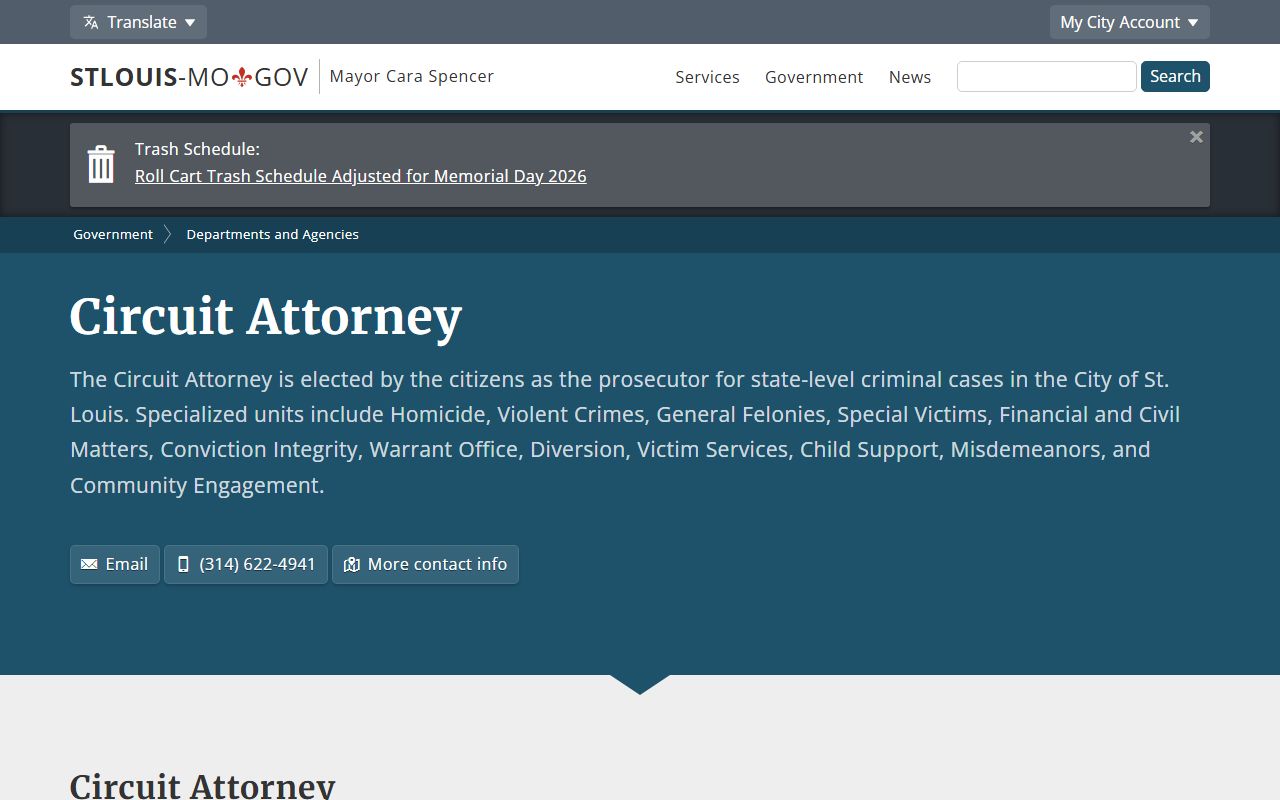
The page explains that the Circuit Attorney prosecutes state crimes inside the City of St. Louis, which ties the arrest stage to the criminal records side of the court.
Victim Services and Crime Records Help
Crime touches victims, and they have a place to turn. Victim Services is a unit inside the Circuit Attorney's Office. It was set up in 1979, and all of its services are free. The unit acts as a link between victims and the criminal justice system, helping people follow a case through arrest, charges, and court.
The unit can be reached at the Circuit Attorney address, 1114 Market Street, Room 401, phone 314-622-4941. Statewide help is also available through the Missouri Victim Assistance Network at 800-698-9199 and the state Crime Victim Services Unit.
The Victim Services page describes the free support and the link it offers between victims and the courts.
For victims tracking a defendant's custody status, release alerts tie into the jail and notification systems covered on the warrant records page and the released-inmate tools.
Warrants, Bond, and Release
An arrest often turns on a warrant or a bond. A warrant is a court order to take a person into custody. Bond is the money or condition that lets a defendant go while the case moves forward. After a city arrest, the jail roster lists the bond amount and bond type tied to the charge.
To post bond, first find out whether the person is held on city or state charges. For city charges, call 314-622-3231. For state charges, call 314-641-8214. Provide the first name, last name, and date of birth to learn the bond amount. Payment in person is cash only, and release after posting can take several hours.
- City charge bond line: 314-622-3231
- State charge bond line: 314-641-8214
- SLMPD Prisoner Processing: 314-241-8339
- City Justice Center: 314-621-5848
Warrant detail, including how to resolve an outstanding warrant, sits on the St. Louis City warrant records page.
Expungement of St. Louis City Criminal Records
Some criminal records can be closed. Missouri law lets qualifying records be expunged by petition. A person files in the civil division of the circuit court and names every court, police agency, prosecutor, and repository that holds the record. The St. Louis fee schedule lists the expungement filing fee at $395.50 plus service.
The court weighs eligibility before it grants the order. It looks at the offense type, the waiting period, paid fines and restitution, pending charges, prior expungements, and public-welfare factors. Denials often come from an excluded offense, not enough time passed, unpaid obligations, or failure to name and serve the right agencies.
The expungement statute, RSMo § 610.140, sets out who qualifies and how the petition works.
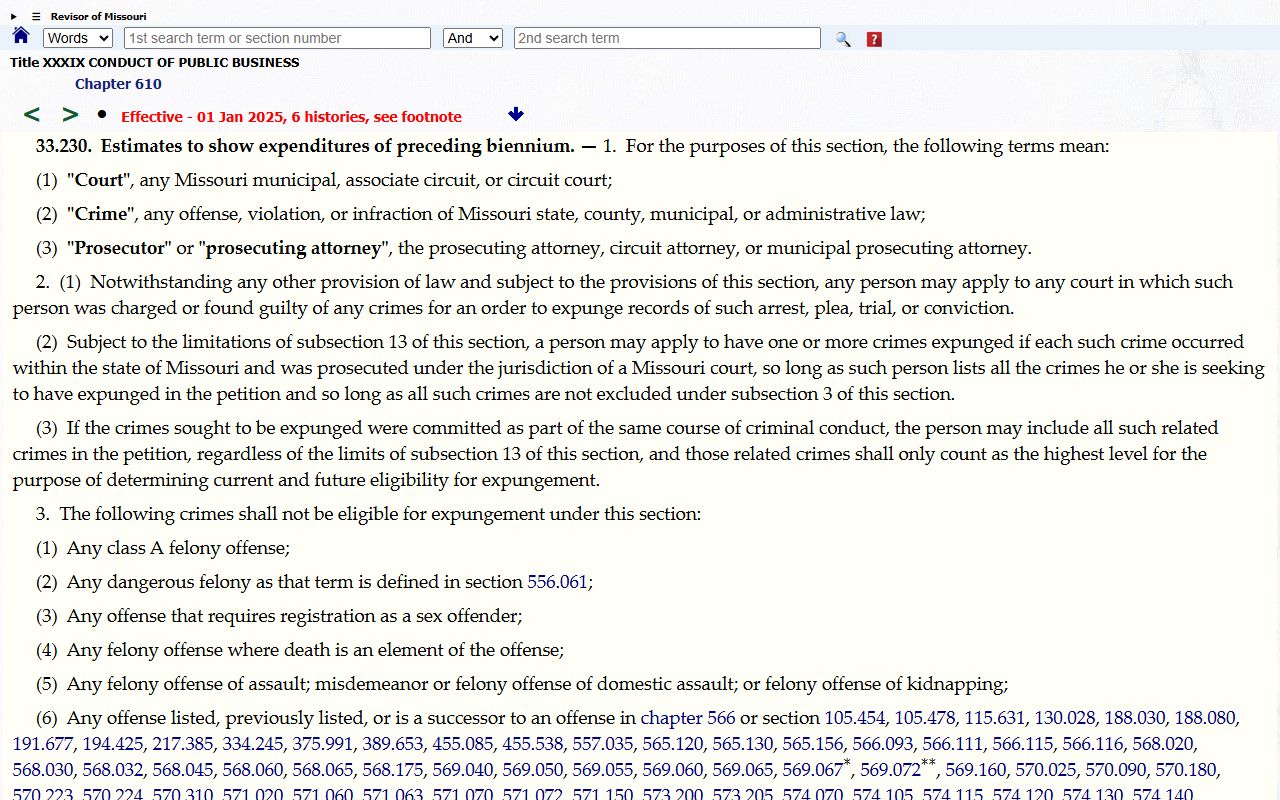
If the court grants expungement, the named offices close the covered St. Louis City criminal records under the closure statute.
Sealed vs Expunged Records
These two terms get used as if they mean the same thing. They do not. A sealed record is closed by law or court order but still exists in the system. An expunged record is closed under the expungement statute, with named agencies ordered to shut public access. Both keep a record off ordinary public search, but the path and the effect differ.
| Sealed Record | Expunged Record |
|---|---|
| Closed by law, rule, or court order | Closed through a 610.140 petition |
| Covers items like juvenile or mental health files | Covers qualifying criminal records |
| Record still exists but is not public | Named agencies close the record under 610.120 |
| Access limited to parties and authorized people | Limited to law enforcement and statutory exceptions |
The closure of records after an expungement order is governed by RSMo § 610.120.
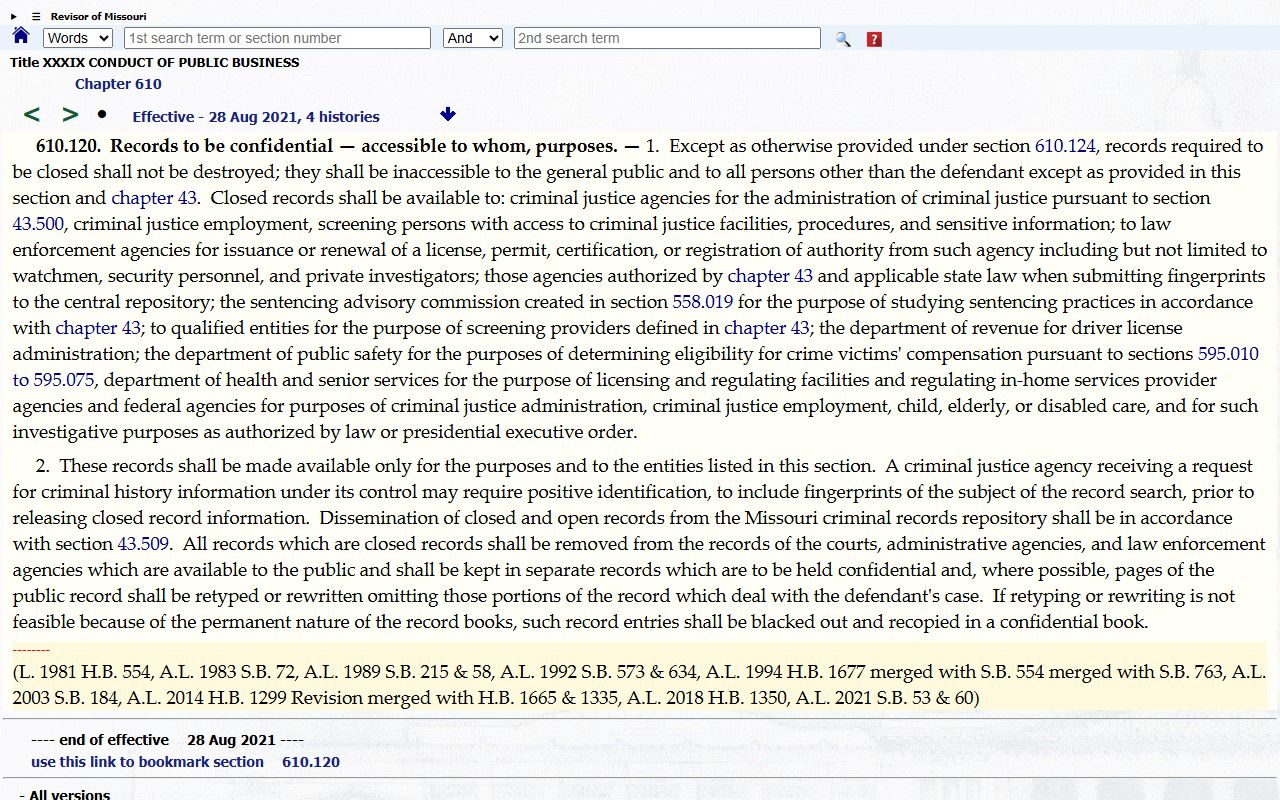
Even after closure, expunged St. Louis City criminal records may stay available to law enforcement and other authorized entities under statutory exceptions.
State Prosecution vs Federal Prosecution
Not every arrest in the city leads to a state case. Some crimes are prosecuted in federal court. St. Louis City sits in the U.S. District Court for the Eastern District of Missouri. The U.S. Attorney's Office for that district handles federal crimes and serves 49 counties from offices in St. Louis and Cape Girardeau.
Federal crimes include things like drug trafficking, financial fraud, firearms offenses, public corruption, child exploitation, and human trafficking. These cases do not appear in Missouri Case.net. Federal records run through PACER instead. So a federal arrest tied to the city will not show in the state court system at all.
The U.S. Attorney's about page explains the federal prosecutor's role and the crimes that office handles.
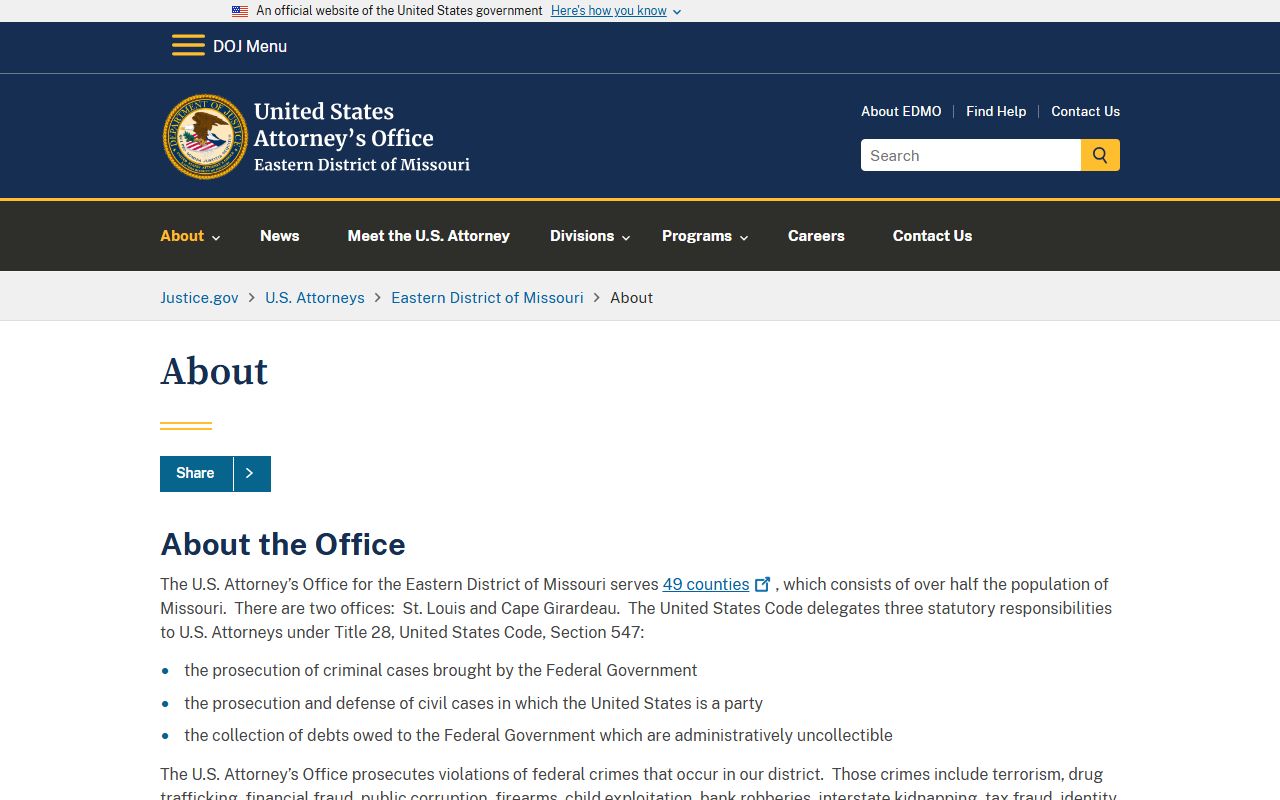
That distinction tells searchers when to look at the state criminal records system and when a federal case keeps records off Case.net entirely.
Restricted Arrest and Criminal Records
Not all arrest data is open. Investigative reports can stay closed while a case is active, even when basic arrest facts are public. Juvenile records are restricted under state law. Sealed warrants and grand jury materials stay confidential before an arrest or service. And personal identifiers like Social Security numbers are redacted from public copies.
Note: An arrest does not mean guilt, so never treat a St. Louis City arrest record as proof of a conviction without checking the court disposition.