
About the St. Louis City Recorder of Deeds
The Recorder of Deeds and Vital Records Registrar serves the City of St. Louis. The office handles marriage licenses, marriage records, land recording, and local vital-record services. Its public-facing front is the Marriage Department, set inside City Hall downtown. This is where a couple applies for a license and where older marriage records are pulled.
The Recorder is a city office, not a court. It does not keep court case files, and it does not hold divorce decrees. Those are court records that sit with the Circuit Clerk. The Recorder's job is to issue marriage licenses, record completed marriages, keep land records, and provide certified and uncertified copies of the records it holds.
St. Louis City Marriage Department
Office: Recorder of Deeds
St. Louis City Hall, Room 128
1200 Market Street
St. Louis, MO 63103
314-613-3018
recorder@stlouis-mo.gov
Mon-Thu 8:00 a.m.-6:00 p.m.
Fri 8:00 a.m.-5:00 p.m., Sat 9:00 a.m.-1:00 p.m.
Why a City Office Does County Work
St. Louis is an independent city. It is not part of St. Louis County, even though the county wraps around it. The city split from the county in 1876 in what locals call the "Great Divorce." Since then, the city has done the work a county government would do in the rest of the state.
That history is the reason the Recorder of Deeds, a city office, handles marriage licenses, marriage records, and land recording. In a typical Missouri county, a county recorder would do this. In St. Louis, the city office fills that role. The same logic explains why the city runs its own jail, its own courts, and its own vital-record functions. For records research, the lesson is simple: do not look for St. Louis City marriage or land records at a county office in Clayton.
The city explains the setup on its city government structure page, which lays out the independent-city status.
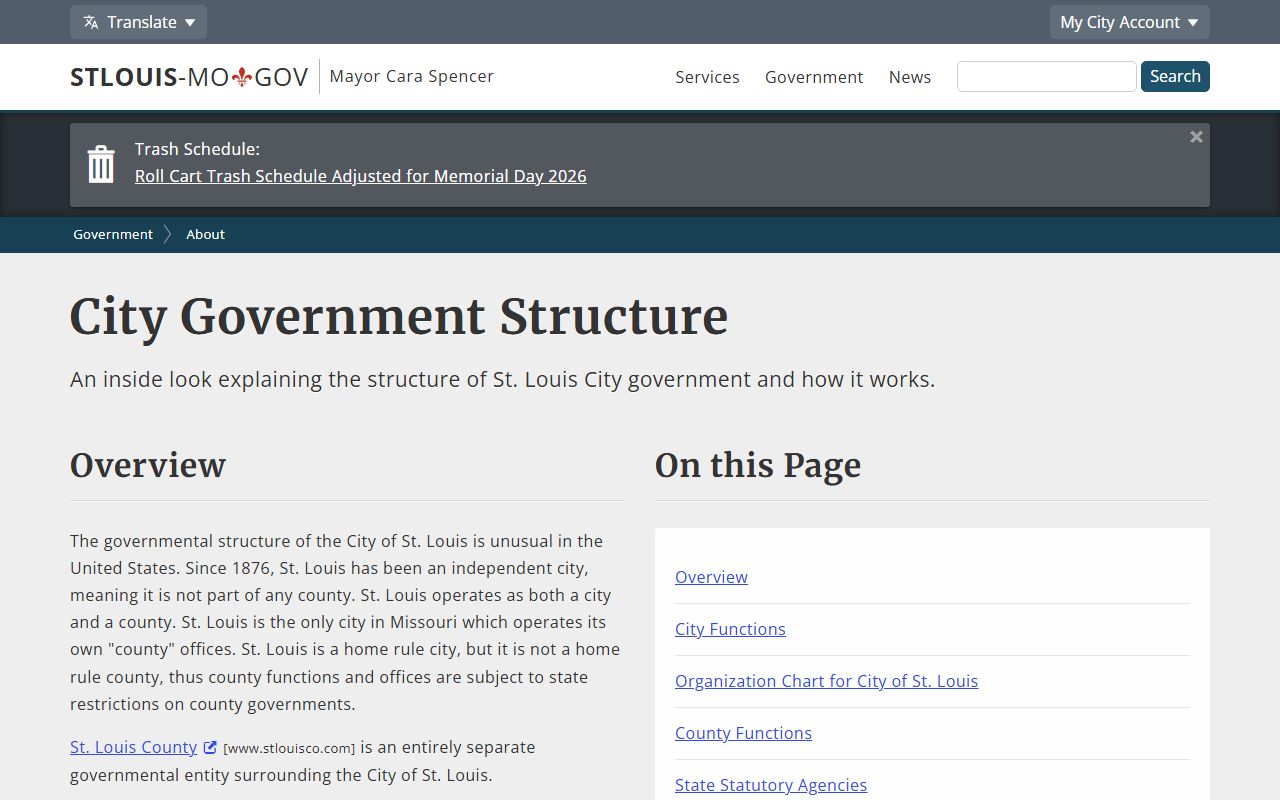
The page notes that because St. Louis stands apart from any county, judicial and revenue functions usually run by a county fall to the City of St. Louis instead.
St. Louis City Marriage License Requirements
A marriage license is issued by the Marriage Department in person. Both applicants must come together to City Hall Room 128. A person can fill out the online application first, but the license is still handed over only during the in-person visit. Each applicant needs a driver's license, a state ID, or a passport that shows the full legal name.
A few rules shape who can get a license and when.
- Both applicants appear together in person with valid ID.
- An applicant must be at least 18, or have legal guardian consent.
- A divorced applicant must wait at least 30 days from the date the divorce was final.
- The fee is $60, nonrefundable, paid by Visa or MasterCard or cash. No checks.
- The license is issued during the visit.
The $60 fee covers a $48 license fee and a $12 certificate copy fee. After the marriage is recorded, the $12 certificate copy is mailed out automatically. Once issued, the license must be used for a ceremony within 29 days. The ceremony must take place in Missouri.
How to Apply for a Marriage License
The steps below trace the full path from application to recorded certificate. Plan for both applicants to be present, and bring a card or cash for the fee. The portal speeds the visit but does not replace it.
- Confirm both applicants meet the age rule and the 30-day divorce-waiting rule.
- Complete the online application first, or plan to fill it out at the office.
- Bring both applicants together to City Hall Room 128 with ID.
- Pay the $60 fee by Visa or MasterCard or cash.
- Receive the license during the visit.
- Hold the ceremony in Missouri within 29 days of pickup.
- Make sure a qualified officiant and two witnesses sign the license.
- The officiant returns the signed license to the Recorder within 15 days.
- Wait for the recorded certificate copy to arrive by mail.
The officiant must be a U.S. citizen who is clergy in good standing with a Missouri congregation, or a judge of a court of record. The city's online marriage license application portal lets a couple start the request before they visit.
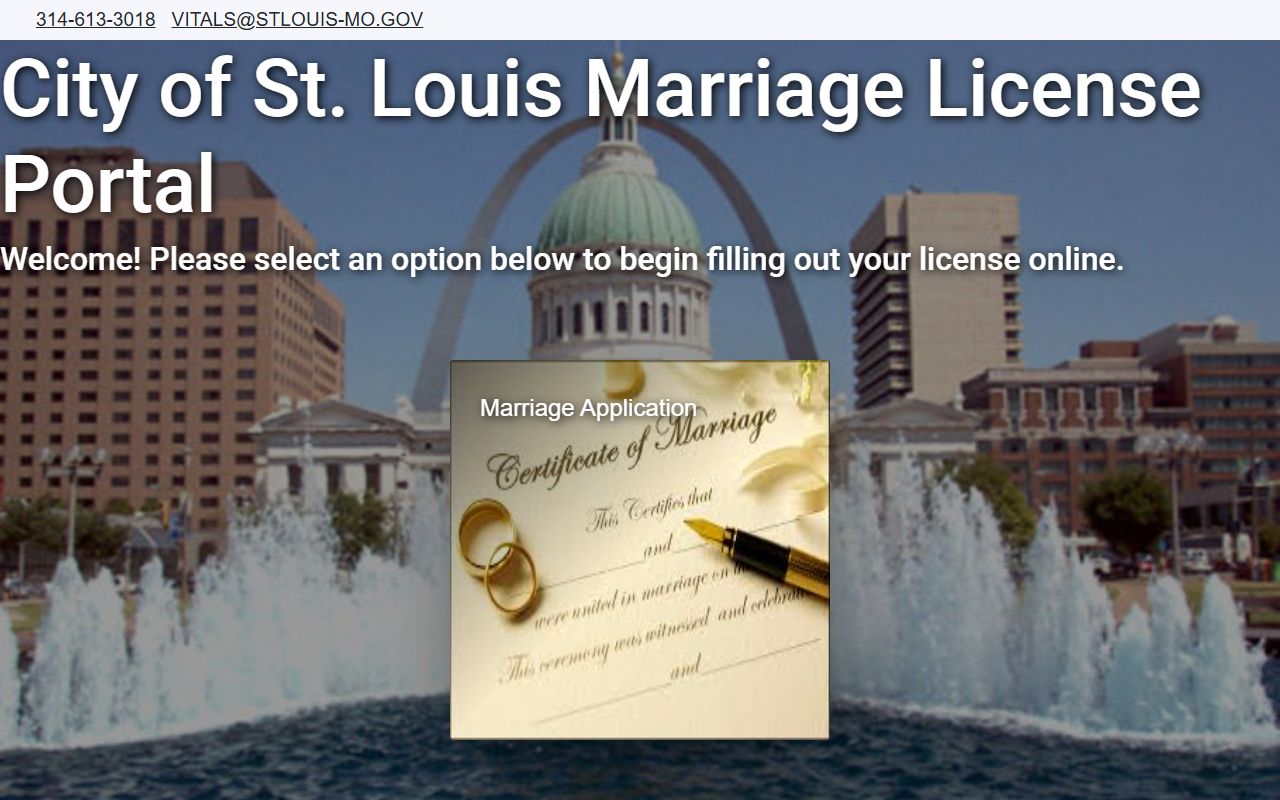
The portal collects the application details, but the city is clear that final issuance still requires both applicants in person with ID.
Searching St. Louis City Marriage Records
The Recorder keeps St. Louis City marriage records from 1932 to the present. A free online search lets a person look up a record by the name of one or both parties. For records before 1932, the city directs people to the Archives Department instead, since those older entries fall outside the online system.
The fields below match the city's online marriage records search.
| Field | Required | Notes |
|---|---|---|
| Party name(s) | One or both parties | Enter the name of one or both spouses. |
| Search button | n/a | Click Search or press Enter to run the lookup. |
| Record coverage | n/a | 1932 to present online; pre-1932 via the Archives Department. |
Run the search through the city's find a marriage record instructions, which point to the public search portal.
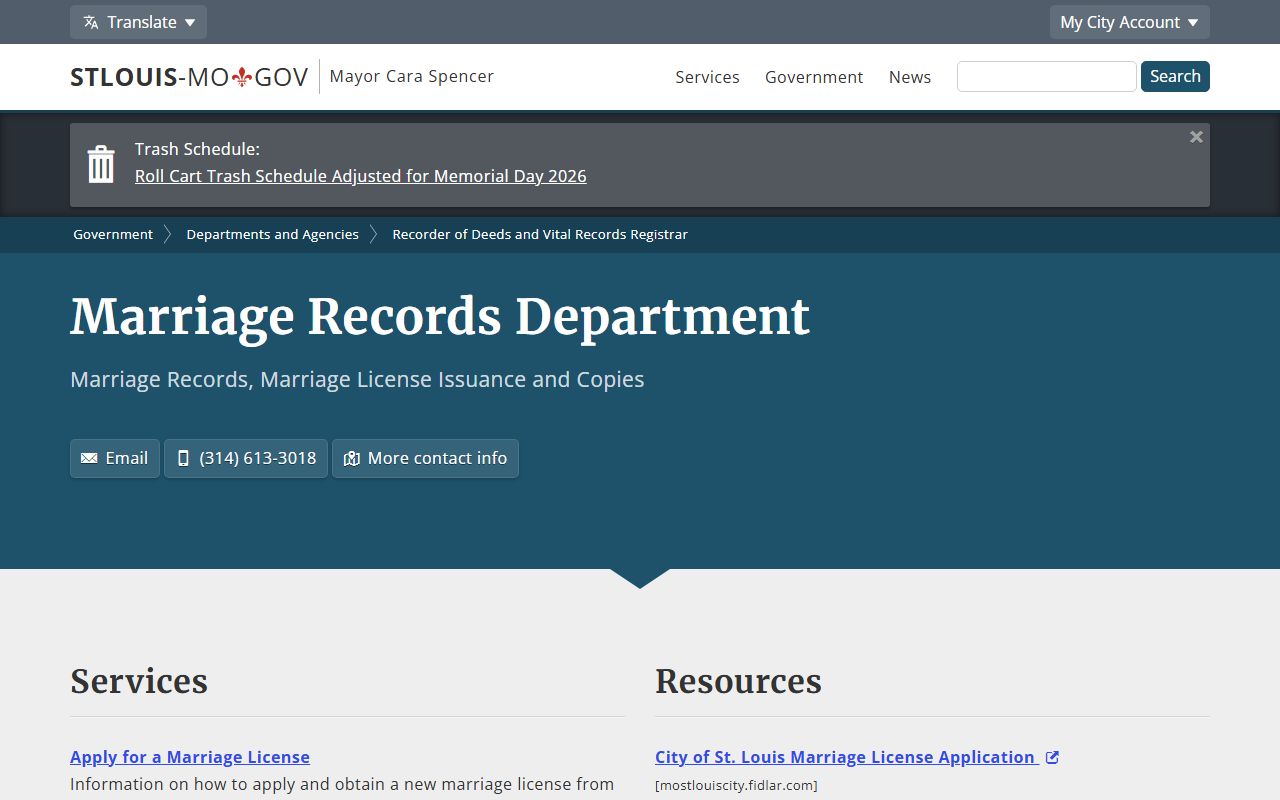
The Marriage Department page also lists the office services, contact details, and the link to the online marriage records search.
Certified vs. Uncertified Marriage Copies
The Recorder provides two kinds of marriage copies. A certified copy carries the office stamp and is accepted for legal use, such as a name change or a benefits claim. An uncertified copy is cheaper and works for reference, but it is not accepted as proof. Pick the type that matches the need before you pay.
| Service | Fee |
|---|---|
| Marriage license application | $60 nonrefundable |
| License fee component | $48 |
| Certificate copy included in license fee | $12 |
| Certified marriage copy, walk-in | $12 each |
| Uncertified marriage copy, walk-in | $3 each |
| Mailing surcharge if no return envelope | $0.50 U.S. / $2 international |
The city explains the request steps and amounts on its copy a marriage license page. A mailed request needs payment and a return envelope, or the mailing surcharge applies.
Land and Deed Recording
Beyond marriage, the Recorder of Deeds records land documents for the City of St. Louis. That includes deeds and other instruments that affect property. Recording puts the document into the public land record so ownership and liens can be traced. This is the city version of the work a county recorder does elsewhere in Missouri.
Land records are a separate track from marriage records and from court files. They are not searched in Case.net, and they are not the same as a property tax record. A deed shows who holds title and when it changed hands. A lien or a release shows a debt tied to the property. Title companies, buyers, and lenders pull these records when a property changes hands. For broader access rules that cover city records like these, see the St. Louis City public records page, which lays out the Sunshine Law framework and request steps.
Where Divorce Records Live
This is the question that sends people to the wrong office. A divorce is a court case. So a divorce record is a court record, and it sits with the Circuit Clerk, not the Recorder. The marriage license that started things came from the Recorder, but the divorce decree that ended things came from the court. The two records live in two different offices.
The Recorder's Marriage Department makes this clear and routes divorce-copy requests to the Circuit Clerk's Office on the 3rd floor of the Civil Courts Building. To find a divorce case, search Case.net under "City of St. Louis - 22nd Judicial Circuit" using a party name or the case number. A divorce filing is a family court matter, with a $177.50 family court deposit and a $36 sheriff service fee per respondent served by the City Sheriff. After judgment, the certified decree comes from the clerk. The marriage and divorce records page covers the full divorce search.
Recorder of Deeds vs. Circuit Clerk
The two offices are easy to confuse, so keep the split clear. The Recorder of Deeds keeps marriage and land records. The Circuit Clerk keeps court case files, including divorce decrees. A divorce is a court case, so even though the marriage license came from the Recorder, the divorce record comes from the clerk.
The Recorder's own page sends divorce-copy requests to the Circuit Clerk's Office on the 3rd floor of the Civil Courts Building. Search the divorce case first in Case.net, then request the certified decree from the clerk. The marriage and divorce records page covers that search in full, and the Circuit Clerk page covers court-file copies. For estate matters tied to a death, see probate records.
Note: Marriage licenses come from the Recorder, but divorce decrees come from the Circuit Clerk, so split a name-change packet between the two offices.