
How to Search St. Louis City Court Records
The main tool is Missouri Case.net. It is the free public portal for cases filed in Missouri courts, and it covers the City of St. Louis. You can search by case number, by litigant name, or by filing date. The one step that matters most is the court dropdown. Pick "City of St. Louis - 22nd Judicial Circuit." That choice keeps your search on city cases and off St. Louis County cases in Clayton. The St. Louis Municipal Court page also notes that the old Municourt.net site no longer works, so all city tickets now run through Case.net too.
Have a few things ready first. The exact legal name helps. A case or citation number helps even more. For a traffic ticket, the citation number sits in the upper right corner of the ticket. Chrome or Edge work best for city municipal cases.
- Open Missouri Case.net in a browser.
- Pick a search type: Case Number, Litigant Name, or Filing Date.
- In "Search for cases in," select "City of St. Louis - 22nd Judicial Circuit."
- Enter the name or case number, then add a date of birth in MM/DD/YYYY form if the name is common.
- For city tickets, set Location to "St. Louis City Municipal" and Case Type to "Traffic/Municipal," then click Find.
For municipal matters, you can select the name first, then click "Get Related Cases" in the right-side column to pull the rest. The city's own municipal case search instructions walk through the same path for traffic and ordinance tickets.
St. Louis City Court Records Search Fields
Case.net uses a small set of fields. Some are required, some only narrow a result. The table below lays out each field for a St. Louis City court records search, based on the Missouri judiciary and city instructions. Required fields depend on which search method you pick.
| Field Label | Type | Required | Notes / Format |
|---|---|---|---|
| Search method | Tab/link | Yes | Case Number, Litigant Name, Filing Date, Scheduled Hearings, or Judgment Index. |
| Search for cases in | Dropdown | Yes | Select "City of St. Louis - 22nd Judicial Circuit." |
| Case Number | Text | For case-number search | Traffic citation number is in the upper right corner of the ticket. |
| Last Name | Text | For name search | Enter the legal spelling. |
| First Name | Text | For name search | City instructions say to enter the first name too. |
| Date of Birth | Date | No | MM/DD/YYYY; narrows a common name. |
| Location | Dropdown | No | Use "St. Louis City Municipal" for city tickets. |
| Case Type | Dropdown | No | Use "Traffic/Municipal" for municipal traffic. |
| Filing Date | Date range | For date search | Now runs by county rather than by circuit. |
A public litigant name search now splits into Person or Organization, a change that took effect May 16, 2025. For court-date tracking and docket entries by case, the St. Louis City court dockets page goes deeper on what each search returns.
Types of St. Louis City Court Records
St. Louis City court records cover many case types. Each lives in a division of the 22nd Circuit or in the Municipal Division. Civil cases include lawsuits, contract disputes, landlord-tenant matters, name changes, garnishments, and judgments. State felony and misdemeanor cases are prosecuted by the Circuit Attorney and heard in the circuit court. Family matters cover divorce, paternity, custody, support, and adoption. Probate covers estates, wills, guardianship, and conservatorship.
The Municipal Division handles city tickets and ordinance cases. Some record types are fully public. Others, like juvenile and adoption files, are closed by law. Here are the main groups people search for in the City of St. Louis.
- Civil records - petitions, answers, motions, orders, judgments, and garnishment papers.
- Criminal records - complaints, indictments, bond orders, pleas, dispositions, and sentencing entries.
- Family records - divorce, custody, support, paternity, and protected adoption matters.
- Probate records - decedent estates, wills, guardianship, and conservatorship cases.
- Traffic and municipal records - city tickets, ordinance cases, and minor criminal matters.
Divorce is a court case, so divorce files sit with the Circuit Clerk on the 3rd floor of the Civil Courts Building. Protection-order petitions are filed with the Circuit Clerk as well, though victim-safety rules can limit what is public.
What St. Louis City Court Records Show
A public case result is built from set fields. Case.net shows index data such as the case number, the parties, the case type, the status, and the docket entries when a record is not confidential. Attorney names and the trial judge can also be public data elements. Some public documents filed on or after July 1, 2023 can be viewed online, with watermarks and redactions. Older or sealed material may not appear at all. The list below shows the fields a typical St. Louis City court records search returns.
- Case Number
- The unique ID for the case in Case.net and the court file.
- Court / Location
- City of St. Louis - 22nd Judicial Circuit, or St. Louis City Municipal for tickets.
- Case Type
- Civil, criminal, traffic/municipal, family, probate, small claims, or protection order.
- Filing Date
- The date the petition, complaint, citation, or application was filed.
- Parties
- Plaintiff and defendant, state and defendant, or petitioner and respondent.
- Docket Entries
- The running log of filings, hearings, and rulings, shown when not confidential.
- Disposition
- The current or final outcome of the charge, claim, or case.
- Documents
- Public documents filed on or after July 1, 2023 may be viewed online, watermarked and redacted.
Note: Case.net is a public service, not a certified record, so a court file copy must come from the Circuit Clerk for legal use.
Public Access Laws for St. Louis City Court Records
Two systems govern access. Missouri's Sunshine Law, Chapter 610 of the Revised Statutes, opens most records held by city agencies such as the Recorder, the Sheriff, and the Corrections Division. Court records follow their own path under Missouri Court Operating Rule 2, which presumes court records are open unless a statute, rule, or order makes them confidential. Both matter for St. Louis City court records, and they do not always overlap. Remote public access through Case.net is narrower than what you may find at a courthouse public access terminal or from the clerk.
Most people do not file a formal request for a court file. They search Case.net, then ask the Circuit Clerk for a certified copy when needed. For city-agency records outside the court system, the Sunshine Law request procedure applies, and copy and research fees are set by RSMo § 610.026. Arrest and incident reports follow RSMo § 610.100, which is why basic arrest data can be open while an active investigation stays closed.
Note: The full Sunshine Law framework, request steps, and city-agency fees are detailed on the St. Louis City public records page.
Records That Are Sealed or Confidential in St. Louis City
Not every St. Louis City court record is open. Several state statutes keep specific files closed. The closed-record list under the Sunshine Law also explains why some related city or law-enforcement records stay private even when a court docket is public.
The closed-record and closed-meeting exceptions in RSMo § 610.021 set out which categories a public body may close, from legal actions to security and records protected by other law.
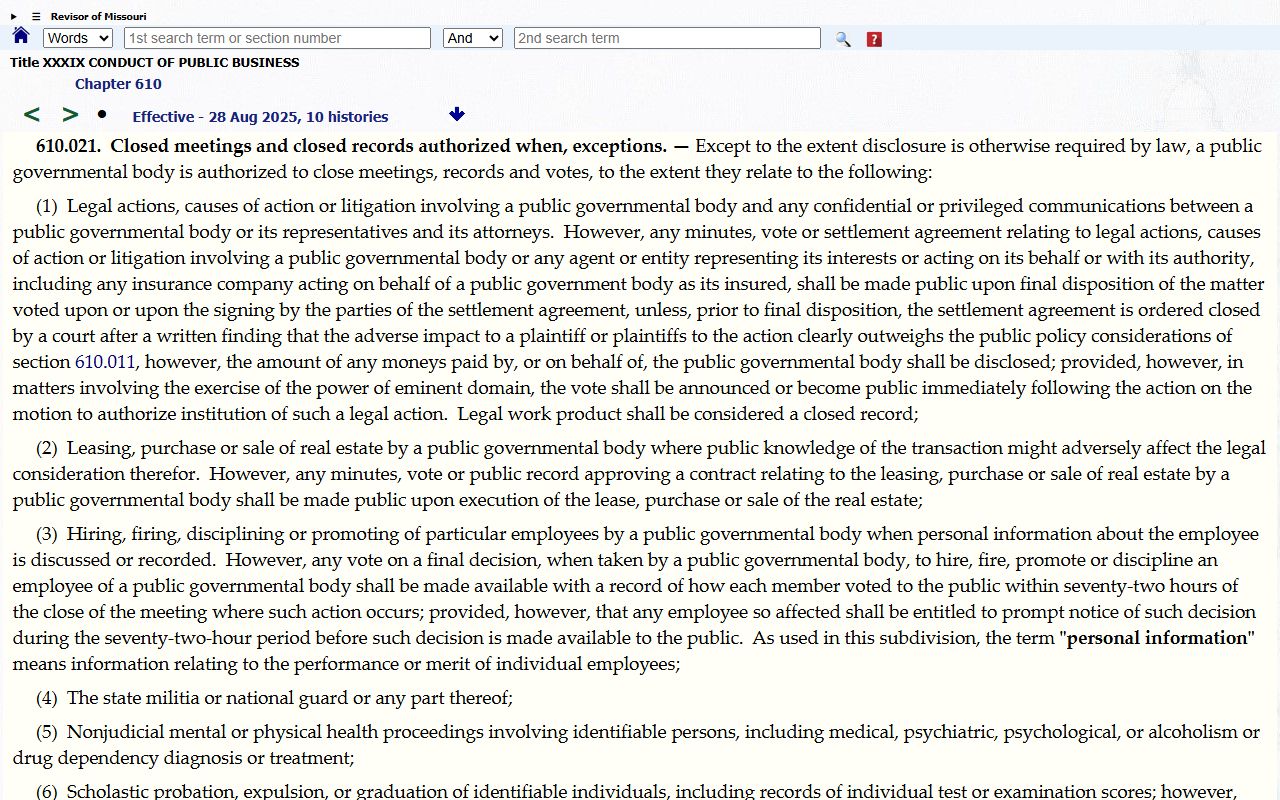
This is the statute that often gets cited when an agency declines to release an investigative or personnel file tied to a case.
Juvenile cases are restricted under a separate law. The confidentiality rule for juvenile court records keeps most juvenile matters out of ordinary public search.
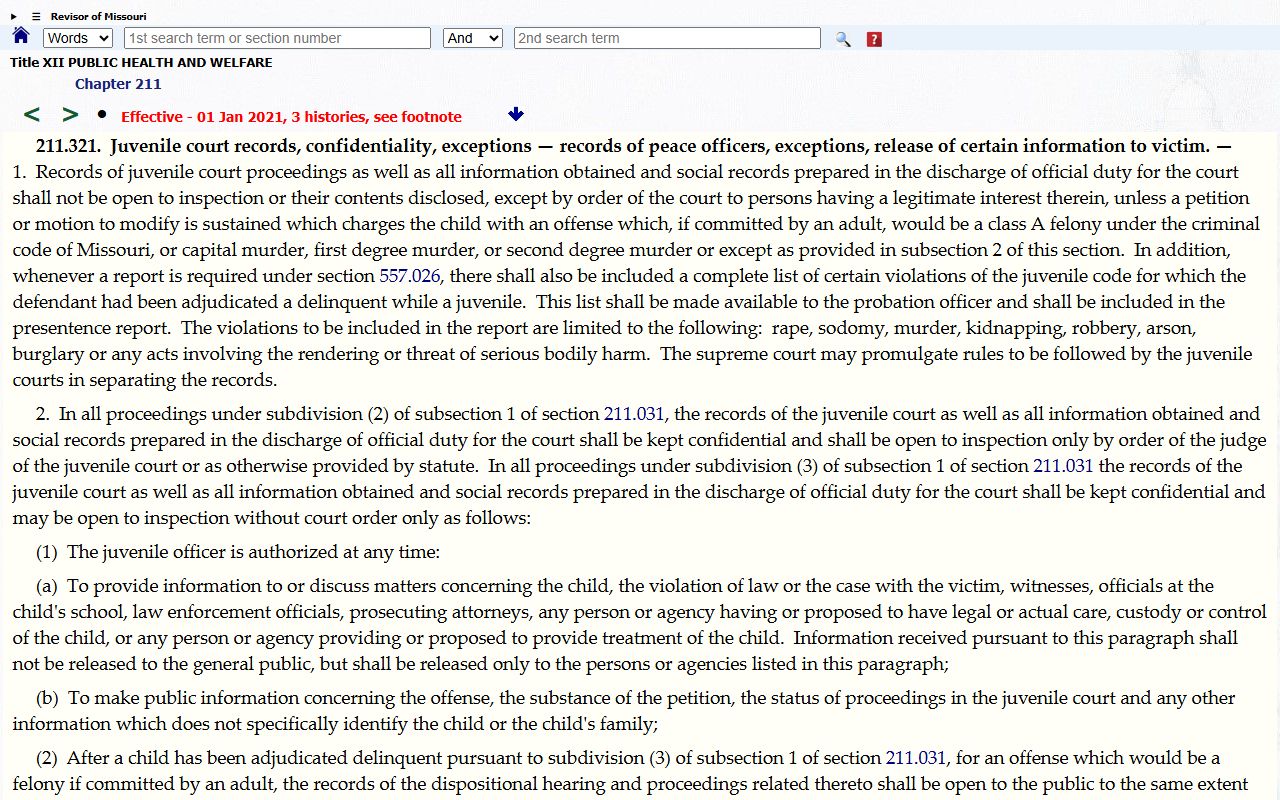
Access to a juvenile file generally belongs to parties, attorneys, agencies, and people the court allows by order.
Adoption files are sealed too. The confidential adoption records statute treats adoption as far more private than an ordinary family case.
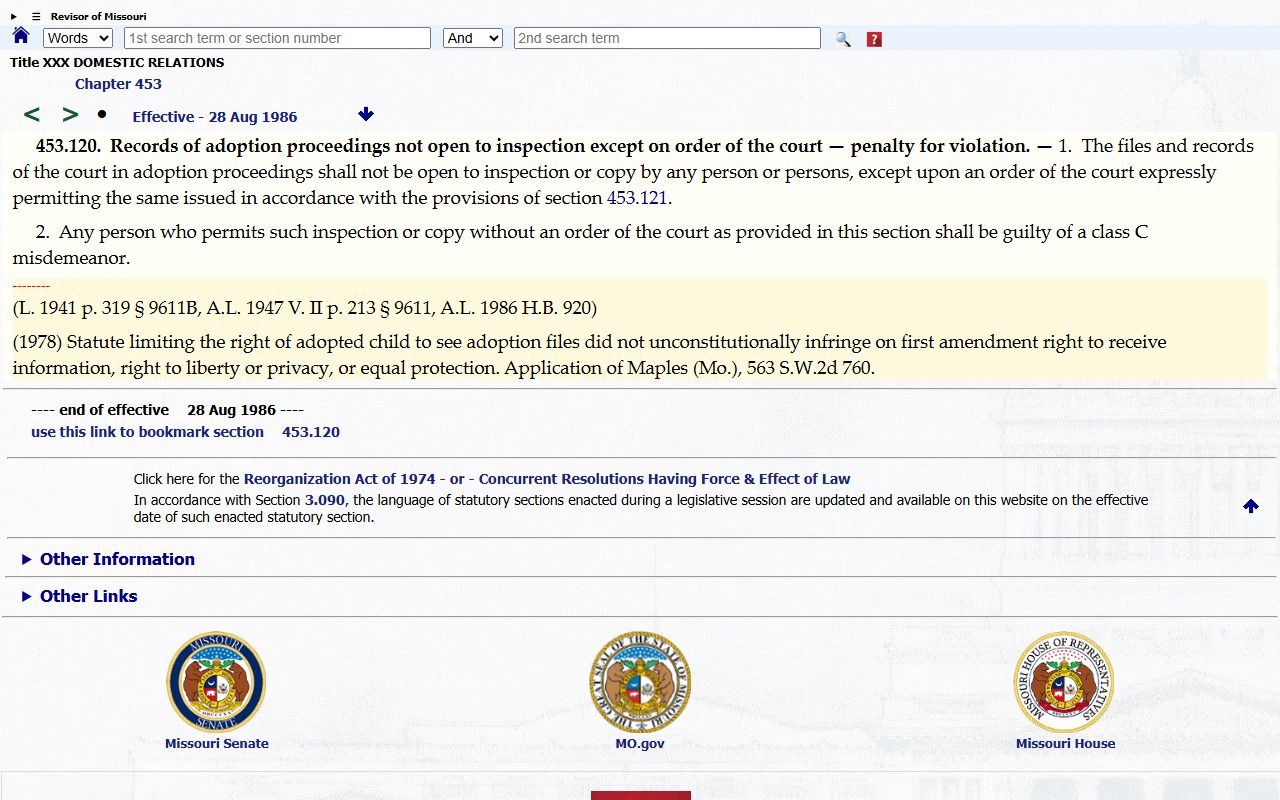
Viewing a sealed adoption record requires statutory authority or a court order. Mental health and civil detention records, plus protection-order safety details, are restricted in the same spirit.
Expungement can close a record for good. A person petitions the civil division of the circuit court, names every agency that holds the record, and asks the court to seal it. The St. Louis fee order lists expungement under RSMo § 610.140 at $395.50 plus service. If the court grants the order, the named offices close the record in the manner the law requires. Expunged files may still reach law enforcement and other authorized users under statutory exceptions.
St. Louis City Court Records Glossary
Court files use shorthand. A few plain definitions make a St. Louis City court records search easier to read. A charge is only an accusation, while a conviction means guilt was found or admitted, so check the disposition before drawing a conclusion.
- Plaintiff
- The person or entity bringing a civil lawsuit.
- Defendant
- The person sued in a civil case or charged in a criminal one.
- Petitioner
- The person asking the court for relief, common in family and probate matters.
- Motion
- A written request asking the court to enter an order.
- Disposition
- The final or current outcome of a charge, claim, or case.
- Judgment
- The court's formal decision resolving claims or setting a money obligation.
- Continuance
- A postponement of a hearing or trial.
- Redaction
- The removal or masking of confidential data in a public copy.
A case dismissed "with prejudice" cannot be refiled on the same claim. One dismissed "without prejudice" may be refiled if the law allows. A bench warrant is issued by a judge, often for a failure to appear.
In-Person Court Record Requests
When you need a paper file or a certified copy, the Circuit Clerk is the office to visit. The clerk keeps the case files, accepts new filings, takes fines and fees, makes copies, and receives protection-order petitions. The office holds about five million files dating from 1804 and takes in roughly 40,000 new civil and criminal cases each year. Bring a photo ID and the case number if you have it. Staff cannot give legal advice, but they can point you to the right window.
St. Louis City Circuit Clerk
10 North Tucker Boulevard
St. Louis, MO 63101
314-622-4433
Mon-Fri 8:30 a.m.-5:00 p.m.
Older or pre-migration cases may not show online. If a citation filed before January 2, 2024 cannot be found, the city tells people to visit the Municipal Court window at 1520 Market Street with a photo ID or call 314-622-3231. Full fee and copy detail sits on the St. Louis City Circuit Clerk page.
Federal Records Are Not in Case.net
Case.net only covers Missouri state courts. Federal cases for St. Louis City are filed in the U.S. District Court for the Eastern District of Missouri, based at the Thomas F. Eagleton U.S. Courthouse downtown. Those records do not appear in any state search. Federal matters include federal crimes, civil rights claims, federal-question civil cases, and habeas corpus. Bankruptcy goes to a separate federal court.
The Eastern District of Missouri court site explains its jurisdiction and how to reach the clerk's office.
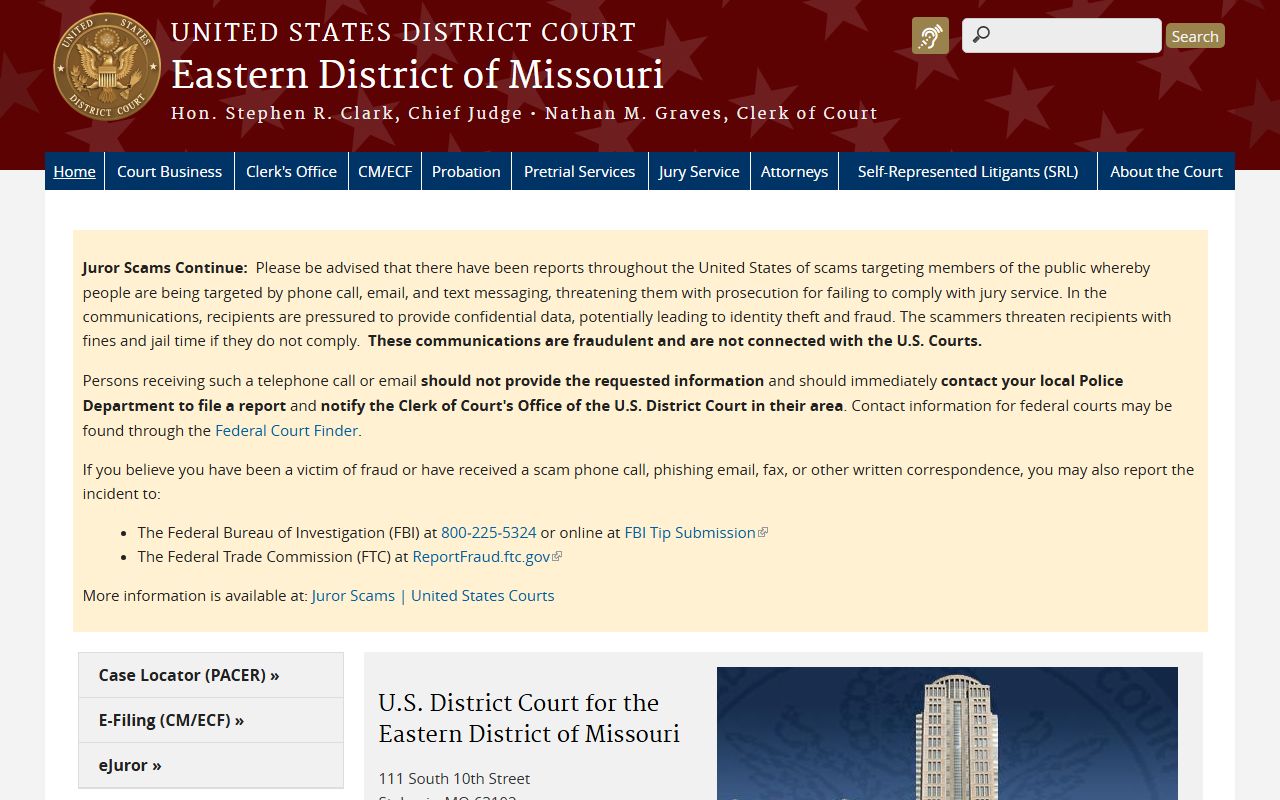
To pull a federal docket or document, you use PACER rather than Case.net, since the two systems do not share data. For state criminal case history that does live in Case.net, the St. Louis City arrest records page covers booking and charge lookups.