
How to Search St. Louis City Court Records
The main tool is Missouri Case.net. It is the free public portal for cases filed in Missouri courts, and it covers the City of St. Louis. You can search by case number, by litigant name, or by filing date. For St. Louis City, the key step is to pick the right court in the dropdown. Choose "City of St. Louis - 22nd Judicial Circuit." That one choice keeps your search on city cases and off St. Louis County cases in Clayton.
Have a few things ready before you start. The exact legal name helps. A case or citation number helps even more. Traffic citation numbers sit in the upper right corner of the ticket.
The official 22nd Judicial Circuit website gives the front door to court services, forms, and division contacts for St. Louis City court records.
The homepage links to the Circuit Clerk, the Probate Division, court forms, and treatment court pages, so it is a good first stop for any St. Louis City court record search.
- Open Missouri Case.net from a browser. Chrome or Edge work best for city cases.
- Pick a search type: Case Number, Litigant Name, or Filing Date.
- In "Search for cases in," select "City of St. Louis - 22nd Judicial Circuit."
- Enter the name or case number, then narrow by date of birth if the name is common.
- For city tickets, set Location to "St. Louis City Municipal" and Case Type to "Traffic/Municipal," then click Find.
The city's own municipal case search instructions walk through the same path for traffic and ordinance tickets.
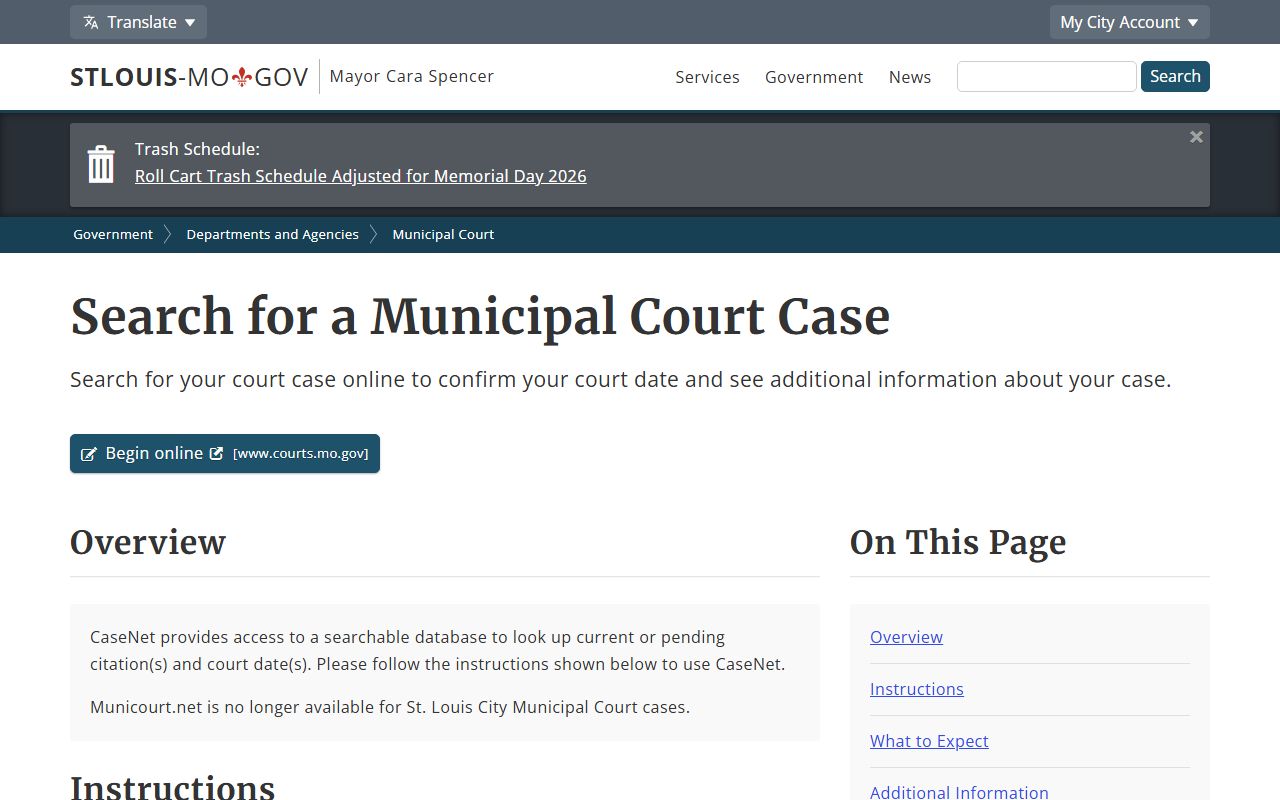
Those steps tell users that Municourt.net no longer works and that all St. Louis City municipal court records now run through Case.net.
St. Louis City Is Not St. Louis County
This point trips up a lot of people. St. Louis is an independent city. It is not part of St. Louis County. The city split from the county in 1876 in what locals call the "Great Divorce." Because the city stands alone, it does the work a county government would do elsewhere. Court records, the jail, marriage licenses, and land records are all city functions.
So a St. Louis City court record will not show up in a St. Louis County search, and the reverse is true too. The county seat is Clayton, and it runs the 21st Judicial Circuit. The city runs the 22nd. When you search Case.net, the dropdown choice "City of St. Louis - 22nd Judicial Circuit" is what keeps you on the city side. Pick the wrong circuit and the record will look missing even when it exists.
Inside the St. Louis City Judicial System
St. Louis City court records flow through a clear set of levels. The Circuit Court is the main trial court. It holds civil, criminal, family, juvenile, and probate dockets. Below it sits the Municipal Division, which handles city tickets and ordinance cases. Appeals go up to the Missouri Court of Appeals, Eastern District. The Supreme Court of Missouri sits at the top and writes the rules that govern public access to court records.
Case flow: Municipal Division › Circuit Court (22nd Judicial Circuit) › Missouri Court of Appeals, Eastern District › Supreme Court of Missouri
| Court | Jurisdiction | Case Types |
|---|---|---|
| Supreme Court of Missouri | Statewide, highest court | Final appeals; court rules and access policy |
| Missouri Court of Appeals, Eastern District | Regional appellate | Most appeals from the 22nd Circuit |
| 22nd Judicial Circuit Court | City of St. Louis | Civil, criminal, family, juvenile, probate |
| Municipal Division | City ordinances | Traffic, minor criminal, truancy, problem property |
The Municipal Court is a division of the 22nd Circuit, not a separate system. Its official Municipal Court page lists what it hears and what it does not.
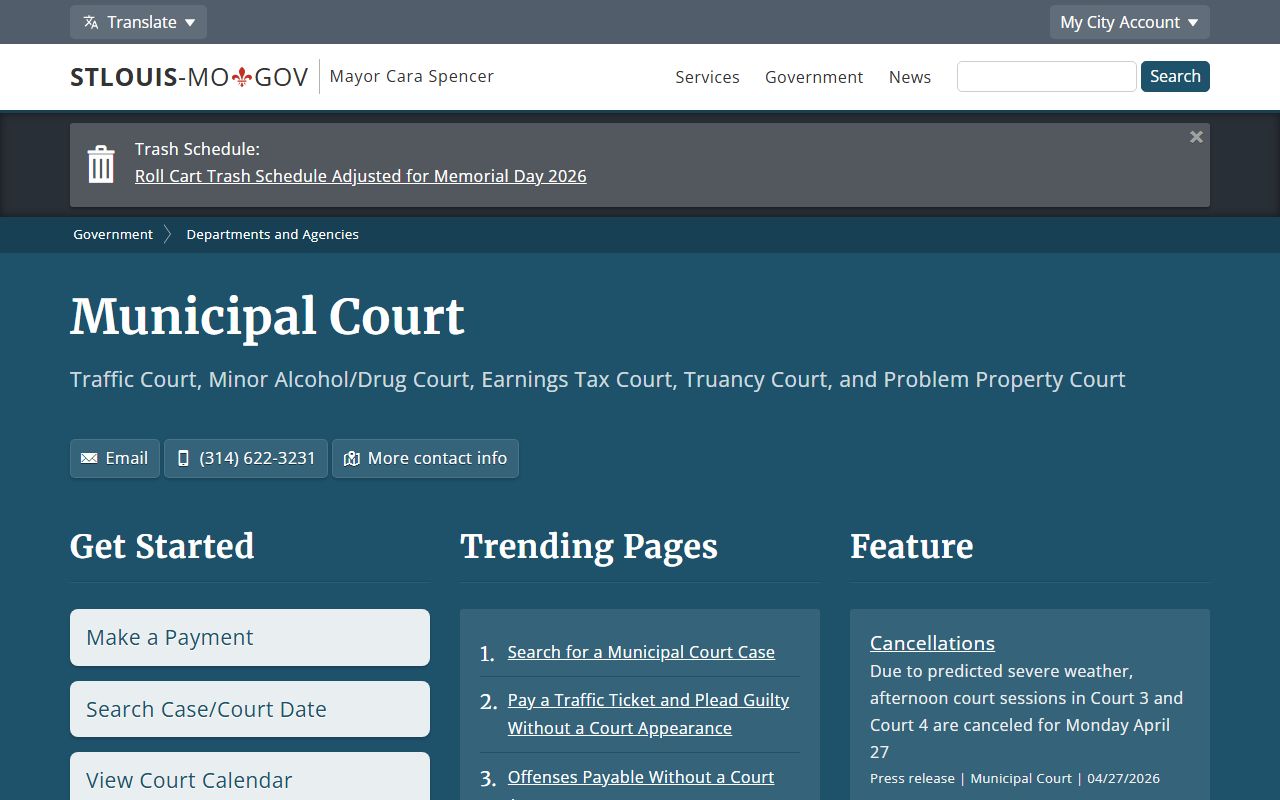
The page is clear that the Municipal Division does not handle divorces, evictions, state felonies, or parking tickets, which all route elsewhere in the St. Louis City court records system.
More detail on the trial court sits on the St. Louis City Circuit Court page, including the full list of judges and divisions.
The Circuit Clerk and St. Louis City Court Files
The Circuit Clerk is the main custodian of St. Louis City court records. The office keeps the case files, accepts new filings, takes fines and fees, makes copies, and receives petitions for orders of protection. The numbers are large. The clerk's office says it holds about five million court files dating from 1804 to the present, and roughly 40,000 new civil and criminal cases are filed each year in the 22nd Judicial Circuit.
That makes the Circuit Clerk the first stop for a certified copy or a paper file. The current clerk is Thomas Kloeppinger, and the office sits in the Clyde S. Cahill Courts Building downtown.
The official Circuit Clerk page lists the office role, address, and file volume.
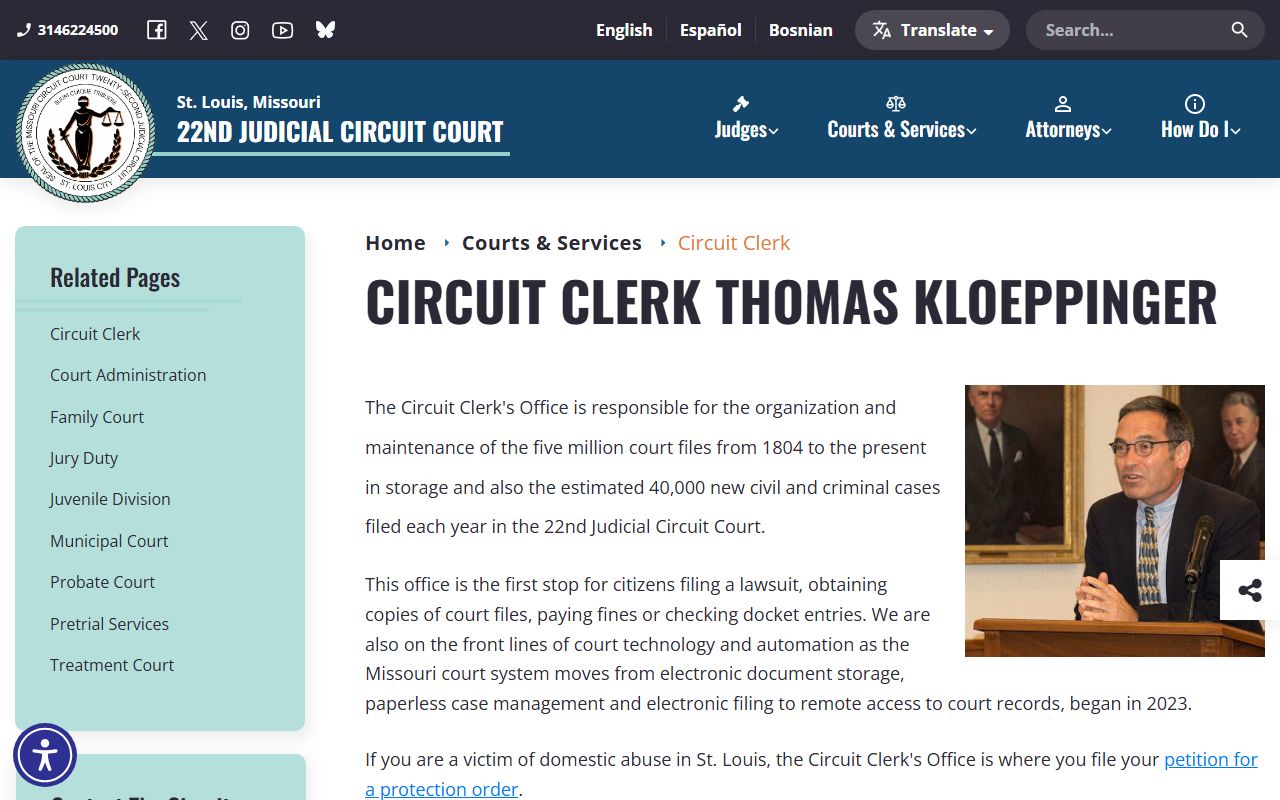
The clerk cannot give legal advice, but staff can help you find the right window for filings, copies, and St. Louis City court records. The full Circuit Clerk page covers fees and copy requests.
Types of St. Louis City Court Records
St. Louis City court records cover many case types. Each type lives in a division of the 22nd Circuit or in the Municipal Division. Some are fully public. Others are closed or limited by law.
Here are the main groups people search for in the City of St. Louis.
- Civil records - lawsuits, contracts, landlord-tenant cases, name changes, judgments, and garnishments.
- Criminal records - state felony and misdemeanor cases prosecuted by the Circuit Attorney.
- Family records - divorce, custody, support, paternity, and adoption matters.
- Probate records - estates, wills, guardianship, and conservatorship cases.
- Traffic and municipal records - city tickets, ordinance cases, and minor criminal matters.
The St. Louis City court records page breaks down each type and shows what a search returns.
What St. Louis City Court Records Show
A public case result is built from set fields. Case.net shows index data such as the case number, the parties, the case type, and the docket entries when a record is not confidential. Some public documents filed on or after July 1, 2023 can be viewed online, with watermarks and redactions. Older or sealed material may not appear at all.
| Field | What It Shows |
|---|---|
| Case Number | The unique ID for the case in Case.net and the court file. |
| Filing Date | The date the petition, complaint, or citation was filed. |
| Parties | Plaintiff and defendant, or petitioner and respondent. |
| Charges / Cause | The charge in a criminal case or the cause of action in a civil one. |
| Disposition | The current or final outcome of the case. |
| Sentence / Judgment | The penalty or money judgment entered by the court. |
Note: Case.net is a public service, not a certified record, so a court file copy must come from the Circuit Clerk for legal use.
Public Access Laws for St. Louis City Court Records
Two systems govern access. Missouri's Sunshine Law, Chapter 610, opens most records held by city agencies like the Recorder, the Sheriff, and the Corrections Division. Court records follow their own path under Missouri Court Operating Rule 2, which presumes court records are open unless a statute, rule, or order makes them confidential. Both matter for St. Louis City court records, and they do not always overlap.
Key Statutes:
RSMo § 610.011 - Declares that records of public bodies are open unless the law says otherwise.
RSMo § 610.100 - Governs arrest and incident reports, so basic arrest data can be open while an active case stays closed.
RSMo § 610.140 - Lets qualifying Missouri criminal records be expunged by petition.
The full framework, including fees and request steps, sits on the St. Louis City public records page.
Records That Are Restricted or Confidential
Not every St. Louis City court record is open. Juvenile cases are restricted under RSMo § 211.321. Adoption files are sealed under RSMo § 453.120. Mental health and civil detention records hold sensitive medical data and stay closed. Protection-order files may be public in part but can hide a victim's address and safety details.
Expungement can close a record for good. A person petitions the circuit court, names every agency that holds the record, and asks the court to seal it. If the court grants the order, the named offices close the record under RSMo § 610.120. To view a sealed file, you generally need to be a party, an attorney, or a person the court allows.
Specialty Courts in St. Louis City
The 22nd Circuit runs treatment courts that mix supervision with care. The goal is to break the cycle of addiction, crime, and jail. Three dockets stand out: Adult Treatment Court, Veterans Court, and Family Treatment Court. Participants get treatment, frequent drug and alcohol testing, case manager meetings, and regular court dates before a commissioner.
Veterans Court diverts military veterans who face mental health or substance issues from the usual criminal process. Adult Treatment Court works with people whose crimes tie back to drug addiction. The official Treatment Court page describes each docket.
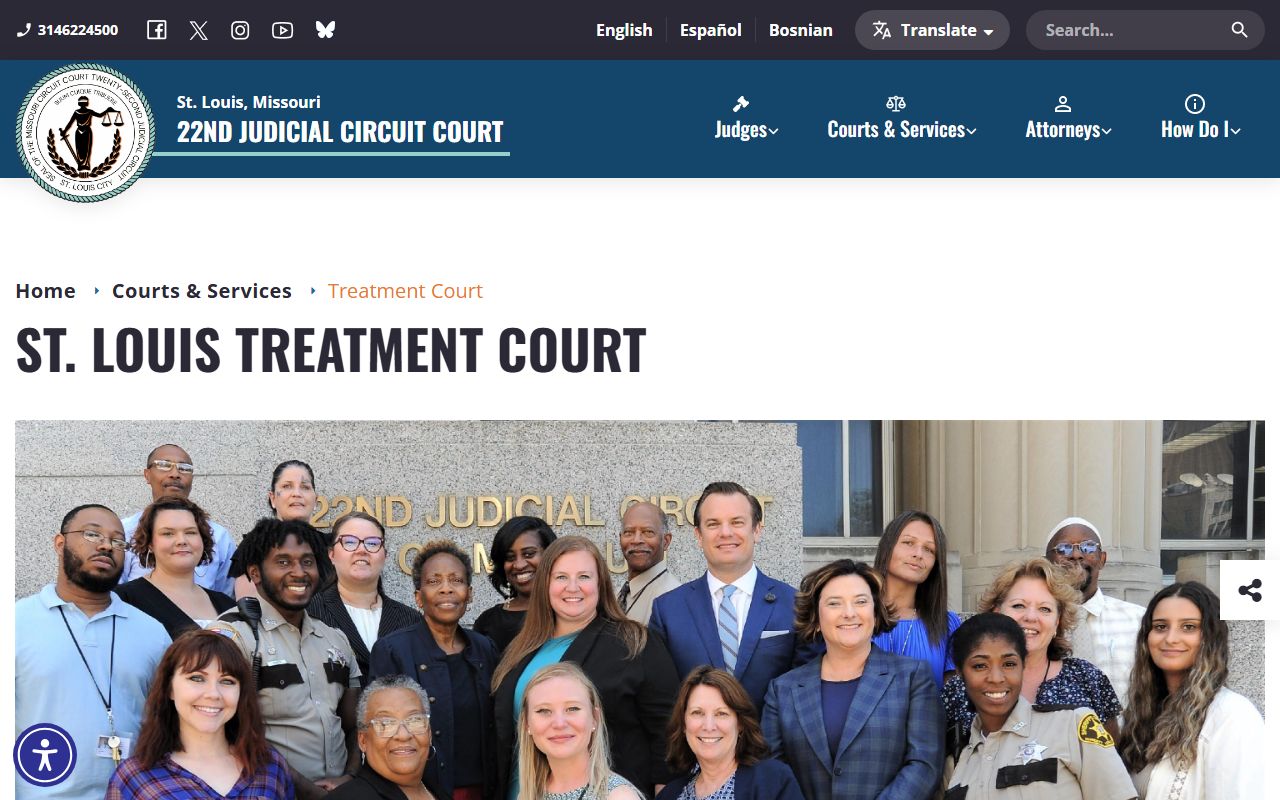
The court reports frequent graduations from these dockets, which shows how active the treatment court records side of the 22nd Circuit has become.
St. Louis City Sheriff and Jail
St. Louis City detention runs through the Division of Corrections, not a rural-style county sheriff. The City Justice Center opened in 2002 and can hold 860 people. People arrested in the city usually go there or stay in police custody first. The Sheriff's Office is a separate body. It guards the courthouse, moves prisoners between buildings, serves court papers, and handles eviction notices and gun permits.
The official City Justice Center page gives the capacity, locator, and population links.
For the roster itself, the St. Louis City inmate records page covers the locator, and the warrant records page covers active warrants and bond.
Marriage, Divorce, and Probate Records
Marriage and divorce split between two offices. The Recorder of Deeds Marriage Department issues licenses and keeps city marriage records from 1932 to the present. Divorce records, though, sit with the Circuit Clerk because divorce is a court case. The marriage and divorce records page sorts out which office holds what.
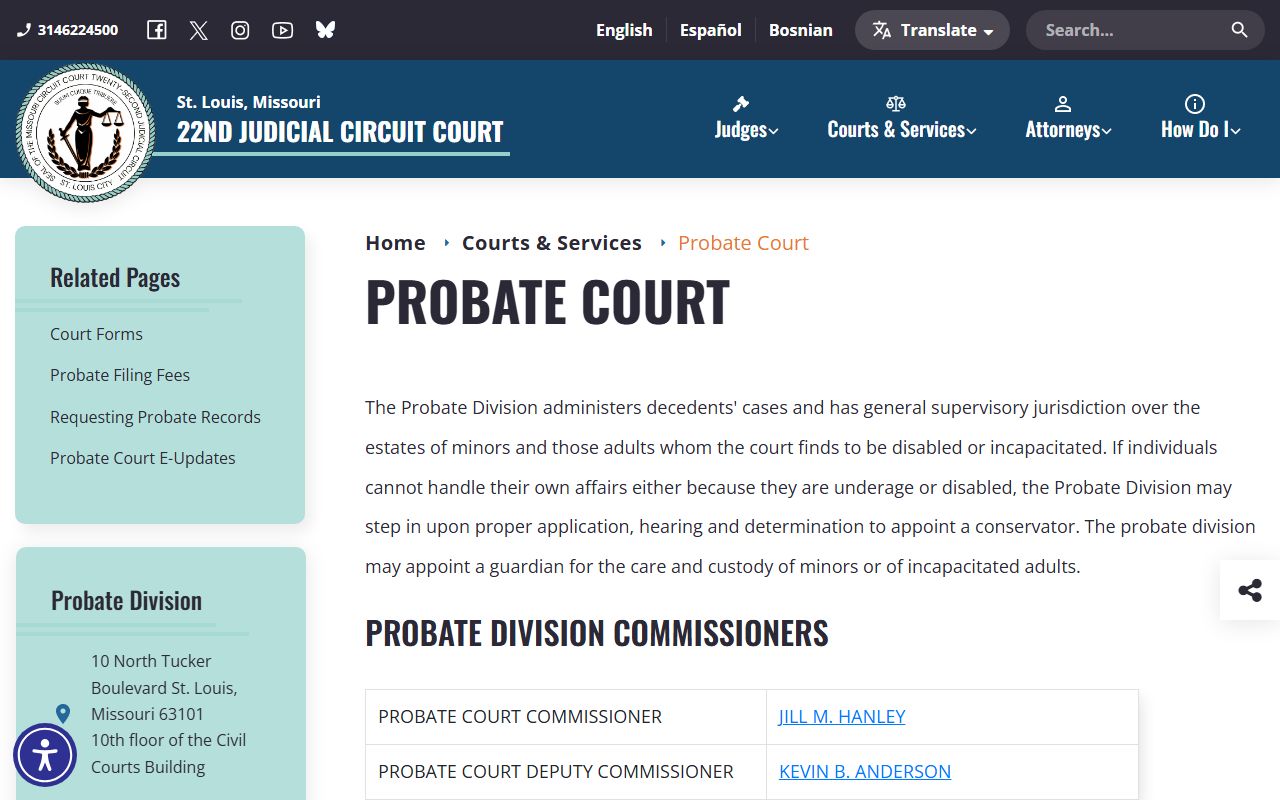
The Probate Division sits on the 10th floor of the Cahill Courts Building. It handles estates of people who have died and oversees guardianship and conservatorship for minors and disabled adults. Its Probate Division page lists the contact block and commissioners.
Older estate files run through a separate index. The Historical Probate Case Index covers decedent estates from 1890 and guardianships back to 1815.
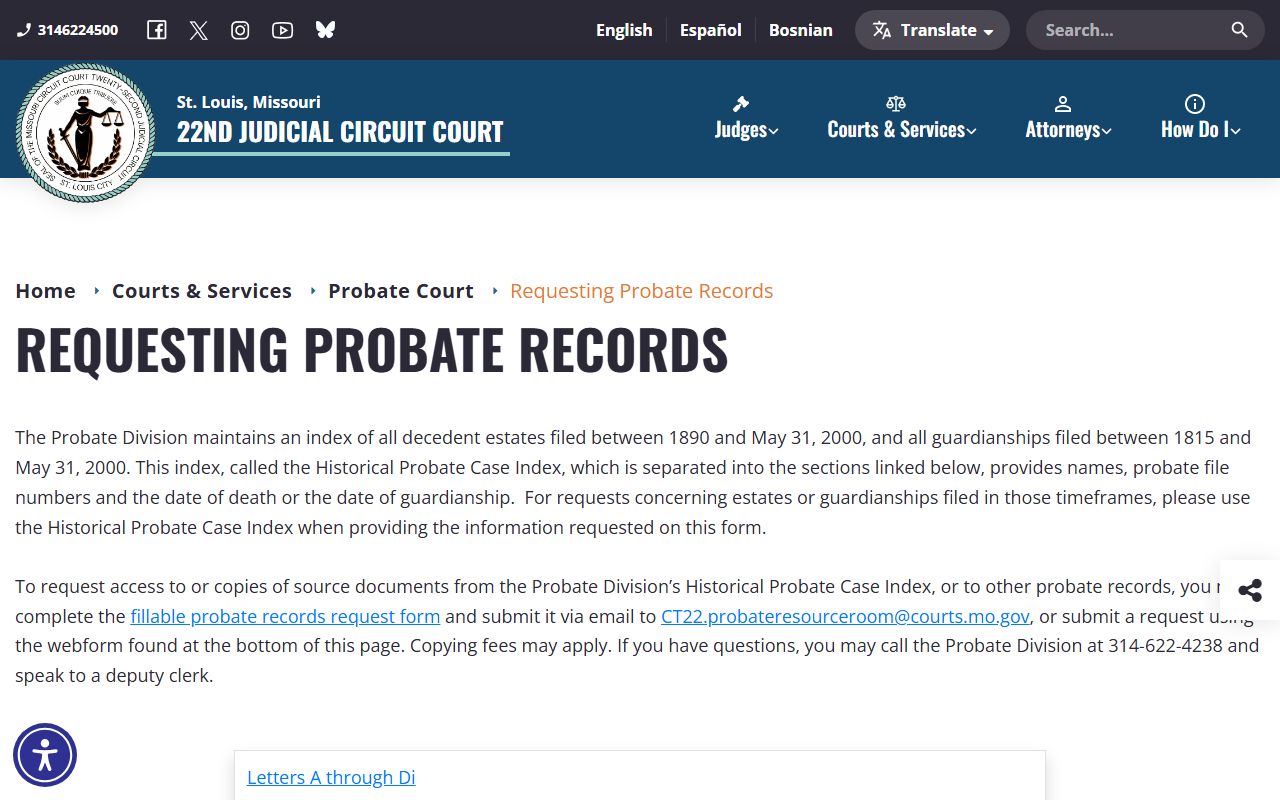
The index gives names, file numbers, and dates so you can request the right probate record. Full detail sits on the probate records page.
- Testator
- A person who makes a will.
- Executor
- The person named to carry out a will.
- Conservator
- A person the court names to manage another adult's money or property.
St. Louis City Court Filing Fees
Court fees in the 22nd Circuit are set by a fee order. The amounts below come from the circuit's 2021 court costs order. They cover the case deposit you pay to start a case plus service fees. Certified copy prices for full court files are best confirmed with the clerk before you pay.
| Item | Amount |
|---|---|
| Associate civil case deposit | $93.50 |
| Circuit civil case deposit | $145.50 |
| Family court matters | $177.50 |
| Small claims under $5,000 | $80.50 |
| Sheriff service per defendant | $36.00 |
| Expungement under 610.140 | $395.50 plus service |
Note: These are filing and service fees, not the per-page copy fees, and amounts can change, so confirm with the Circuit Clerk before filing.
How to Read St. Louis City Court Records
Court files use shorthand. A docket is the running log of every event in a case. Each line is a docket entry, like "petition filed" or "warrant issued." A disposition is the outcome. A charge is only an accusation, while a conviction means guilt was found or admitted. An arrest is not a conviction, and many cases end without one.
When you read a St. Louis City court record, check the disposition before you draw a conclusion. A pending case has no final result yet. A dismissed case ended without a finding of guilt. The court records page includes a fuller glossary of these terms.
Accuracy and Record Limitations
Online data lags real life. The city says a new traffic ticket takes a few days to show in Case.net. Cases filed before full migration may not appear online at all. The inmate locator returns only exact name matches, so a misspelling can hide a real record.
Note: Always confirm a name, date, or outcome with the Circuit Clerk or Municipal Court before you rely on a St. Louis City court record for any decision.
History of St. Louis City Courts
The court-record trail here is older than the state. The Circuit Clerk keeps files from 1804, which predates Missouri statehood in 1821. The city broke from St. Louis County in 1876, and the 22nd Judicial Circuit has matched the city ever since.
The main building, once the Civil Courts Building, was renamed the Clyde S. Cahill Courts Building in 2024. The court has also moved fast on technology. Missouri shifted from paper storage to electronic filing and then to remote access to court records starting in 2023, and the 22nd Circuit launched a new website in 2024.
St. Louis City Court Records FAQ
How do I search St. Louis City court records?
Use Missouri Case.net. Select "City of St. Louis - 22nd Judicial Circuit," then search by case number, name, or filing date. For city tickets, set Location to "St. Louis City Municipal" and Case Type to "Traffic/Municipal." The portal is free, but it is a public service and not a certified record.
Where do I get divorce records?
Divorce records are court records, so they sit with the Circuit Clerk, not the Recorder. The Recorder's page says divorce copies are available on the 3rd floor of the Civil Courts Building. Search the case in Case.net first if you know a party name or case number.
Why can't I find my traffic ticket?
There is processing time after a citation is issued. Wait a few days and check Case.net again. If the ticket is older or filed before January 2, 2024, call 314-622-3231 or visit the Municipal Court window at 1520 Market Street with a photo ID.
More answers sit on the St. Louis City Court records FAQ page.