
About the St. Louis City Circuit Clerk
The Circuit Clerk serves the City of St. Louis, which is Missouri's 22nd Judicial Circuit. The current clerk is Thomas Kloeppinger. The office is not a court. It is the records and filing arm of the court. Staff accept new lawsuits, keep the case files in order, take fines and fees, make copies, and receive petitions for orders of protection. The clerk is the first stop for citizens who file suit or need a paper from a case.
The scale of the office is large. The Circuit Clerk says it organizes and maintains about five million court files dating from 1804 to the present. Roughly 40,000 new civil and criminal cases are filed each year in the circuit. Those files predate Missouri statehood, which came in 1821, so the record trail here is older than the state itself. The office sits inside the Clyde S. Cahill Courts Building downtown, the same building that holds many circuit courtrooms and the Probate Division.
The city keeps a reference page for the office with its Circuit Clerk address, hours, and file-volume summary.
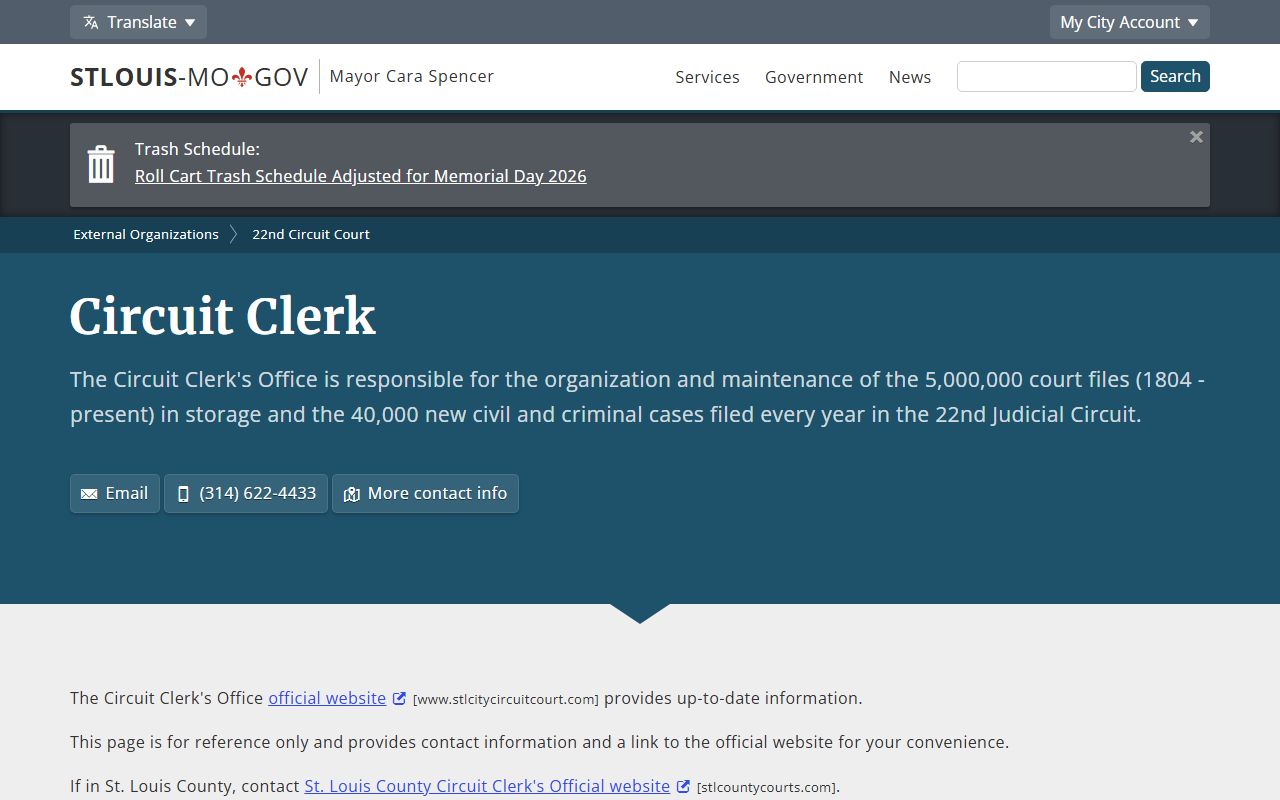
That page confirms the Tucker Boulevard address and the weekday hours used by anyone seeking St. Louis City court records from the clerk.
St. Louis City Circuit Clerk
Clerk: Thomas Kloeppinger
Clyde S. Cahill Courts Building
10 North Tucker Boulevard
St. Louis, MO 63101
314-622-4433
Court contact line: 314-622-4044
Mon-Fri 8:30 a.m.-5:00 p.m.
What the St. Louis City Circuit Clerk Does
The clerk's work touches every case in the 22nd Circuit. When a lawsuit starts, the clerk takes the filing and opens a file. As the case moves, the clerk records each step in the docket. When a case ends, the file stays with the clerk. The office also collects the money the court is owed, from filing deposits to fines, and it issues the copies people need for legal use.
Here are the core public-facing duties of the office.
- Accept new civil and criminal filings for the circuit.
- Keep and organize the court case files.
- Log docket entries for each case event.
- Collect court fines, fees, and case deposits.
- Provide copies of court files, including certified copies.
- Receive petitions for orders of protection from abuse victims.
One thing the clerk will not do is give legal advice. Staff can tell you which window to use and which form to file. They cannot tell you what to write or how your case should come out. For that, you need a lawyer. The clerk's role is to keep St. Louis City court records moving and available, not to argue any side.
St. Louis City Court Forms and Filings
The 22nd Circuit publishes a forms library for self-represented litigants and attorneys alike. It covers family matters, probate, guardianship, conservatorship, protection orders, and civil detention. People who file without a lawyer lean on these forms most. The clerk accepts the completed forms and opens or updates the matching court file.
The court keeps the full set online through its court forms library, sorted by case type.
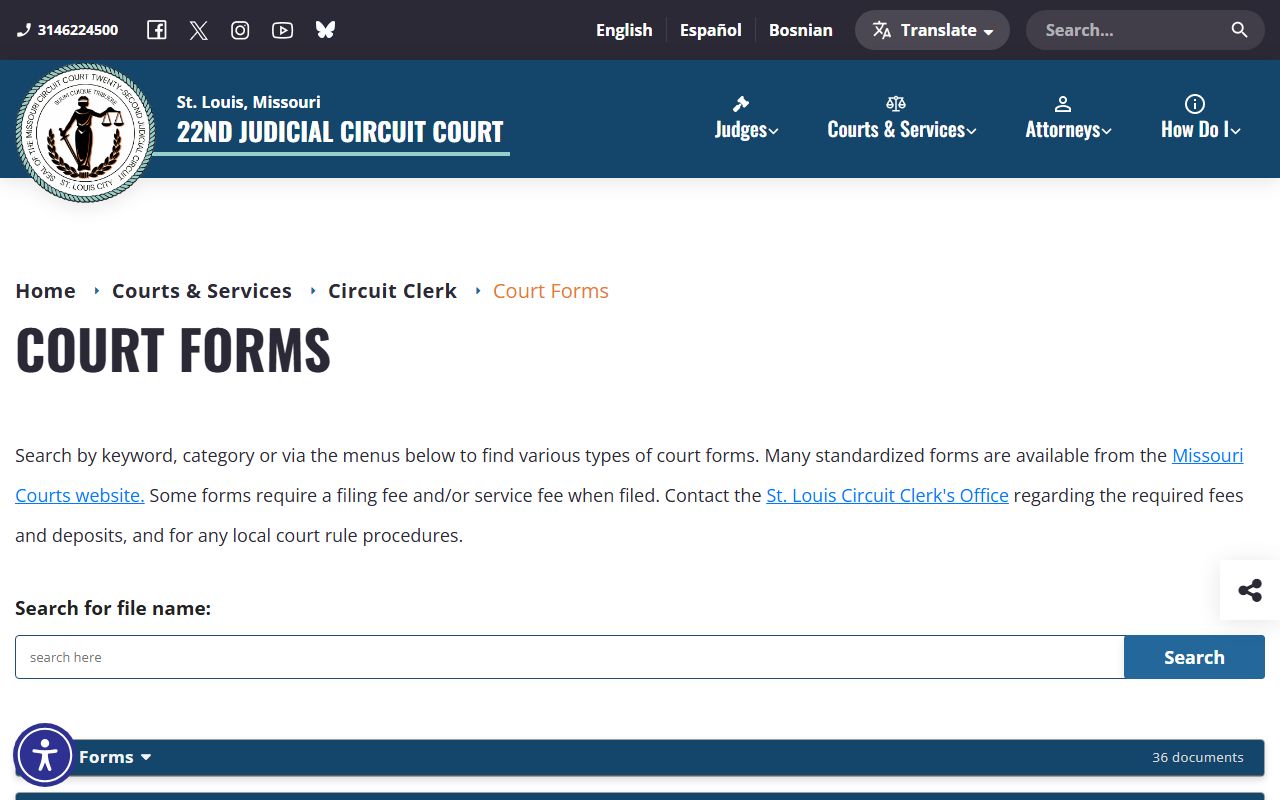
The library groups forms so a person filing a guardianship case, a divorce, or a protection-order petition can find the right packet without guessing. Forms filed with the clerk become part of the St. Louis City court records file once accepted.
How to Request a Certified Copy
A certified copy is a court-stamped paper that proves a record is true and complete. Courts, agencies, and other states accept certified copies. A plain printout from a search site does not carry that weight. Case.net is a public service, not a certified record, so a stamped copy for legal use must come from the Circuit Clerk. Many people need certified copies of judgments, divorce decrees, or orders.
- Find the case number first. Search the name or citation in Missouri Case.net under "City of St. Louis - 22nd Judicial Circuit."
- Note the parties, the case type, and the document you need, such as a judgment or a decree.
- Contact the Circuit Clerk's Office or use its "Request Certified Copies" link to ask for the copy.
- Pay the copy and certification fee. Confirm the exact per-page amount with the clerk before you pay.
- Pick the copy up at the window or wait for it by mail, depending on how the request is made.
Divorce decrees follow this same path. The Recorder's Marriage Department points divorce-copy requests to the Circuit Clerk's Office on the 3rd floor of the Civil Courts Building. More on that split sits on the marriage and divorce records page.
Records Request Fields for the Circuit Clerk
A clean request gets a faster answer. The clerk needs enough detail to pull the right file out of millions. The fields below are the basics to have ready, whether you ask in person, by mail, or through the court's request link. The more exact the case data, the less chance staff pull the wrong record.
| Field | Required | Notes |
|---|---|---|
| Case Number | Strongly preferred | Find it on Case.net before you request a copy. |
| Party Names | Yes | Full legal names of the parties in the case. |
| Document Type | Yes | Judgment, decree, order, or full file. |
| Certified or Plain | Yes | Certified for legal use; plain for reference. |
| Number of Copies | Yes | Used to figure the fee. |
| Requestor Contact | Yes | Mailing address and phone for return of the copy. |
Note: A misspelled name or a missing case number slows the search, so confirm the spelling on Case.net before you send a request to the clerk.
Visiting the St. Louis City Circuit Clerk
The clerk's office is inside the Clyde S. Cahill Courts Building at 10 N. Tucker Boulevard. People who come in for St. Louis City court records pass through metal detectors, and bags are screened at the door. Weapons, needles, pocket knives, scissors, and pepper spray are not allowed and may be taken at the entrance. Jurors get free validated parking at Kiel Garage, 1515 Clark Avenue, once per day. Other visitors should confirm rates at the garage before they arrive.
The court posts the full parking and security rules for the Cahill Courts Building.
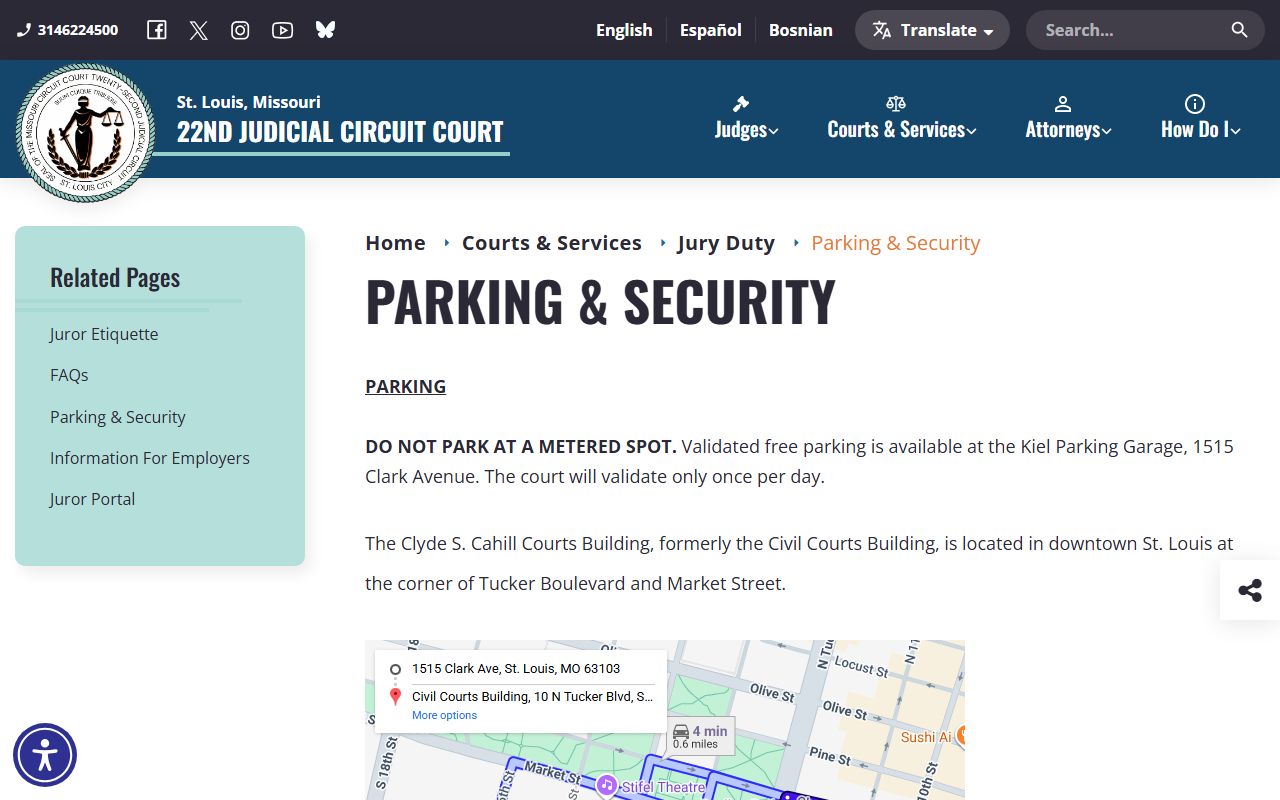
The page covers validated juror parking, the shuttle from Kiel Garage, and the screening every visitor passes through before reaching the Circuit Clerk window.
St. Louis City Circuit Clerk Fees
Court fees in the 22nd Circuit are set by a fee order. The amounts below come from the circuit's court costs and sheriff's fees order effective July 1, 2021. Most are case deposits you pay to start a matter, plus service fees the clerk collects. They are separate from the per-page copy fees, which the clerk confirms at the time of a copy request.
| Filing or Service | Amount |
|---|---|
| Associate civil case deposit | $93.50 |
| Circuit civil case deposit | $145.50 |
| Family court matters | $177.50 |
| Small claims under $5,000 | $80.50 |
| Sheriff service per defendant | $36.00 |
| Certified mail service per defendant | $10.04 |
| Expungement under 610.140 | $395.50 plus service |
| Trial de novo | $45.00 |
| Appeal | $70.00 |
| Garnishment | $10.00 |
The full schedule lives in the circuit's court costs and sheriff's fees order. Fees can change, so check the current order before filing.
Protection Orders at the Circuit Clerk
The Circuit Clerk is where victims of domestic abuse in St. Louis file petitions for orders of protection. The clerk takes the petition and opens the case. A protection-order file can hold the petition, an ex parte order, service returns, hearing dates, the full order, and any later changes or dismissals. Some of that file is public, but parts can be hidden to keep a victim safe.
Protection-order access is shaped by victim-safety rules under RSMo § 455.504, which deals with confidentiality in these cases.
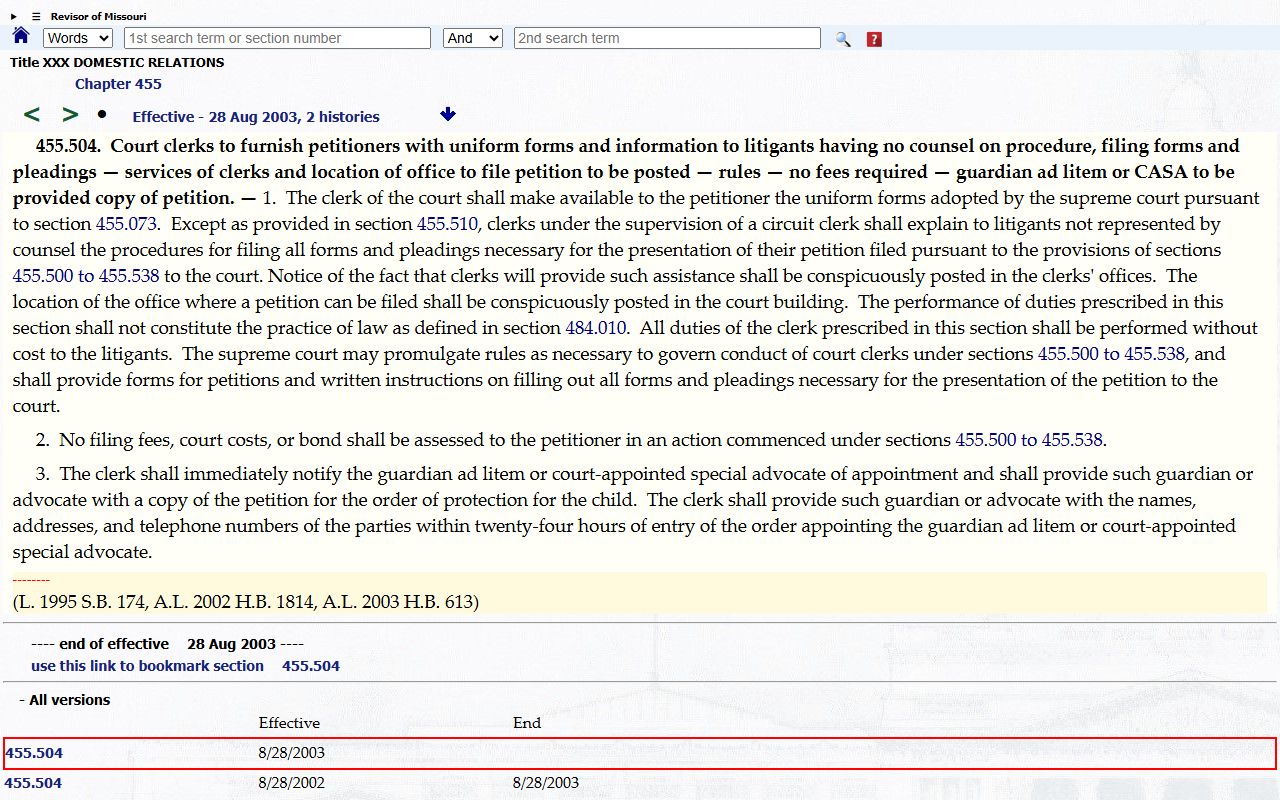
That statute is why an address, a safety plan, or minor information may be left out of a public protection-order record even when the case itself shows on the docket. The clerk takes the filing but cannot give legal advice on the petition.
E-Filing and Remote Access
The Circuit Clerk has moved with the state's push toward digital court records. Missouri shifted from electronic document storage and paperless case management to electronic filing, and then to remote access to court records starting in 2023. The clerk's office describes St. Louis as being on the front line of that court technology change.
For the public, the key tool is Missouri Case.net. It is the free portal for case information in the 22nd Circuit. Public documents filed on or after July 1, 2023 may be viewed remotely for certain public case documents, subject to redaction and confidentiality rules. Public documents carry a watermark, in effect since October 20, 2023. Older files and sealed material may not appear online at all and must be requested from the clerk.
The court records page walks through Case.net search steps, and the court dockets page covers how to read the running case log the clerk maintains.
Circuit Clerk vs. Recorder of Deeds
People often mix up the two offices. The Circuit Clerk and the Recorder of Deeds are not the same. The Circuit Clerk keeps court case files. The Recorder of Deeds and Vital Records Registrar keeps marriage licenses, marriage records, and land records. St. Louis is an independent city, so both offices carry duties that county offices handle elsewhere.
| Record | Circuit Clerk | Recorder of Deeds |
|---|---|---|
| Court case files | Yes | No |
| Divorce decrees | Yes (court case) | No |
| Marriage licenses | No | Yes |
| Marriage records | No | Yes |
| Land and deed records | No | Yes |
| Protection-order petitions | Yes | No |
So a divorce decree is a court record from the Circuit Clerk, while the marriage license that came before it is a Recorder record. The Recorder of Deeds page covers the marriage and land side in full.